
- All
- Product Name
- Product Keyword
- Product Model
- Product Summary
- Product Description
- Multi Field Search
Views: 162 Author: Site Editor Publish Time: 2026-01-16 Origin: Site
If you are designing a machine that requires linear motion, you have likely encountered a common engineering dilemma: should you use a ball screw or a lead screw?
At a glance, these two components look remarkably similar. Both feature a threaded shaft and a nut that travels along it, converting rotational motion from a motor into linear movement. However, despite their visual resemblance, they function on entirely different mechanical principles. Choosing the wrong one can lead to oversized motors, excessive noise, premature failure, or unnecessary costs.
This guide breaks down the mechanics, performance differences, and ideal applications for both technologies. Whether you are building a high-precision CNC machine or a simple 3D printer, understanding the “ball screw vs lead screw” debate is essential for optimizing your design.
The choice between these two drive systems usually comes down to specific application requirements regarding precision, load, and budget.
A ball screw is a high-performance mechanical linear actuator that uses recirculating ball bearings to minimize friction. It is the gold standard for industrial machinery requiring high speed and accuracy.
A lead screw, sometimes called a power screw or translation screw, relies on sliding friction between the nut and the screw threads. It is generally simpler, quieter, and more cost-effective.
Understanding why these differences matter in motion control is crucial. The drive system dictates your motor size, your maintenance schedule, and the overall lifespan of your machine.
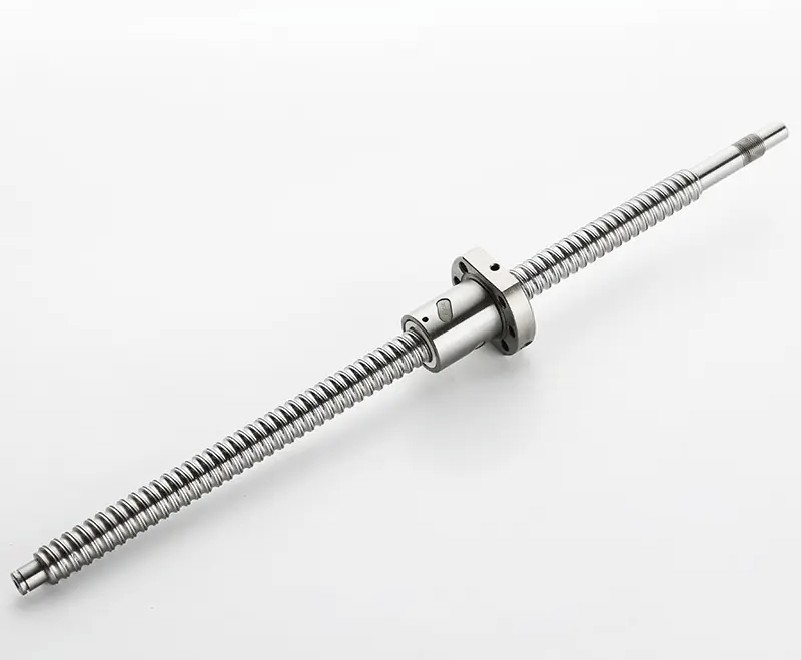
To understand the performance gap between different linear motion systems, it’s essential to first examine how a ball screw is constructed. A ball screw is specifically engineered to minimize friction where heavy loads and precise movement are involved. Its design replaces traditional sliding contact with a rolling interface, which dramatically improves efficiency and reduces wear. A typical ball screw assembly consists of three core components: a hardened steel screw shaft with precision-cut helical grooves, a ball nut that travels along the shaft, and a set of recirculating steel ball bearings positioned between them.
The working principle of a ball screw is defined by this rolling contact. As the screw shaft rotates, the balls roll smoothly within the grooves, carrying the load between the nut and the shaft rather than allowing the two surfaces to slide directly against each other. Once the balls reach the end of the nut, an internal return mechanism guides them back to the starting point, forming a continuous circulation loop. This recirculation process allows the nut to move along the shaft with minimal resistance.
Because a ball screw operates on rolling friction instead of sliding friction, it can convert rotary motion into linear motion with exceptionally high efficiency-often exceeding 90%. This results in lower heat generation, reduced energy loss, smoother motion, and significantly higher speed and accuracy compared to conventional lead screw systems.
A lead screw is the simpler, older cousin of the ball screw. Its design has been used for centuries, dating back to simple presses and vices.
The lead screw assembly is mechanically straightforward:
Screw shaft: Typically made of carbon steel or stainless steel with a trapezoidal or ACME thread profile.
Lead nut: Usually made from a softer material than the screw, such as bronze, plastic, or polymer.
Lead screws operate on the principle of sliding friction. The threads of the nut are in direct surface contact with the threads of the screw. When the screw turns, the nut slides along the ramp of the thread.
Because there are no rolling elements, the contact area is much larger. This results in higher friction, which generates heat and wear but also provides specific mechanical advantages, such as the ability to hold a load in place without power.
Self-locking capability: Due to high friction and specific thread angles, many lead screws cannot be back-driven. If you apply a vertical load, the nut won’t spin down on its own.
Simple design: With no moving parts inside the nut, there is less that can go wrong.
Low manufacturing cost: They are significantly cheaper to produce than ball screws.
Easy maintenance: Many modern lead nuts use self-lubricating polymers, eliminating the need for messy grease.
When selecting components, you need to compare them across several performance metrics. Here is how they stack up.
The fundamental difference lies in the contact type. Ball screws use rolling contact, point-to-point support provided by the ball bearings. Lead screws use sliding contact, a line of surface area where the nut drags across the screw. This physics difference dictates almost every other performance characteristic.
Efficiency refers to how well the screw converts rotary power (torque) into linear movement.
Ball Screws: Extremely high efficiency, typically around 90%. This means a smaller motor can drive a heavier load.
Lead Screws: Lower efficiency, ranging from 30% to 80%. A significant portion of the input energy is lost as heat due to friction. You typically need a larger motor to move the same load compared to a ball screw.
Ball Screws: These are designed for precision. Manufacturers can preload the ball bearings to remove “play” between the nut and screw. This results in near-zero backlash, making them ideal for applications requiring positioning accuracy down to the micron.
Lead Screws: Because they rely on a sliding fit, there must be some clearance between the threads to prevent binding. This clearance creates backlash (lost motion when changing direction). While anti-backlash nuts exist, they introduce more friction and can wear out over time.
Ball Screws: The low friction allows for high-speed operation without overheating. The steel-on-steel design also supports heavy axial loads.
Lead Screws: High speeds generate excessive heat due to friction, which can melt plastic nuts or seize metal ones. They are limited to lower speeds (duty cycles) and generally lighter loads compared to similarly sized ball screws.
Lead Screws: Without recirculating balls, lead screws are very quiet. The sliding motion is smooth and vibration-free.
Ball Screws: The sound of steel balls clicking as they enter and exit the recirculation tubes can generate noise, making them louder than lead screws.
Ball Screws: Rolling elements experience very little wear. With proper lubrication, a ball screw can last for millions of cycles with no change in accuracy.
Lead Screws: Friction equals wear. The nut is essentially a consumable item. Over time, the internal threads of the nut will wear down, increasing backlash and reducing accuracy.
Lead Screws: Significantly lower initial cost.
Ball Screws: Higher initial cost due to the complexity of manufacturing hardened steel shafts and precision ball bearings. However, lower operating costs (smaller motors, less energy) can offset this in high-duty applications.
The rolling motion allows ball screws to run cool and efficient. This is vital for continuous industrial applications where energy consumption and heat generation are concerns.
For tasks like CNC machining or semiconductor manufacturing, the ability to return to the exact same position thousands of times is non-negotiable. Ball screws maintain this accuracy over their lifespan better than sliding screws.
If your machine needs to traverse a long distance quickly, a ball screw is the superior choice. It generates minimal heat, allowing for sustained high-speed travel.
Because you aren’t fighting friction, you can often downsize the motor and gearbox, potentially saving money on the drive electronics.
Ball screws are robust. They do not suffer from the “stick-slip” phenomenon and wear down very slowly, making them ideal for machines that run 24/7.
This is the lead screw’s superpower. In vertical lifting applications, a ball screw will “back-drive” (fall down) if power is lost, requiring a brake. A lead screw often resists this due to internal friction, adding a layer of safety without extra hardware.
For hobbyists, prototypes, or simple transfer systems, the price difference is substantial. A lead screw setup can cost a fraction of a ball screw assembly.
Lead screws are compact and require fewer components. They can be easily customized with different nut materials (like Teflon-coated polymers) to suit specific environments.
If you only need to move a component once an hour or make small adjustments, the high performance of a ball screw is overkill. A lead screw performs this task perfectly well for less money.
Higher cost: They are precision components and priced accordingly.
Not inherently self-locking: If the motor cuts out, the load can crash down. They almost always require a separate braking system for Z-axis use.
Sensitive to contamination: If dust or chips get into the ball nut, they can jam the recirculation tracks. They require bellows or covers in dirty environments.
Low efficiency: The energy loss to friction is significant.
High friction and heat: They are not suitable for continuous, high-speed movement.
Faster wear: The nut will eventually wear out and need replacement.
Limited speed and accuracy: They cannot match the travel speed or the tight tolerance positioning of a ball screw.
Winner: Ball Screw
CNC mills, routers, and lathes require high force to cut metal and extreme precision to hold tolerances. A lead screw would wear out too quickly and introduce too much play (backlash) for precision cutting.
Winner: Depends on the specific task
For high-speed pick-and-place robots, ball screws are preferred. For simple push-pull actuators where speed is low, lead screws are sufficient and cost-effective.
Winner: Lead Screw
In a lab setting, the noise of recirculating balls can be disruptive. Lead screws offer the silent, smooth operation required for syringe pumps, fluid handling, and scanning equipment.
Winner: Lead Screw (mostly)
Most desktop 3D printers use lead screws for the Z-axis. The movement is slow, and the self-locking feature keeps the gantry from falling when the print finishes. However, high-end industrial printers may use ball screws for speed.
Winner: Lead Screw
The safety factor of self-locking makes lead screws excellent for adjustable desks, jacks, and lifting platforms where back-driving is a safety hazard.
| Selection Factor | What to Consider | Why It Matters |
|---|---|---|
| Stroke Length | Is the required travel distance very long? | Long lead screws can “whip” at high speeds, reducing stability and accuracy. |
| Accuracy Tolerance | Do you need high precision or just basic movement? | Ball screws offer much higher positioning accuracy than lead screws. |
| Operating Speed | Will the system run at high RPM or continuous speed? | Friction heat at high speed can deform or melt a lead screw nut. |
| Environmental Exposure | Will the system be exposed to dust, dirt, or sawdust? | Ball screws are more sensitive to contamination and may require better sealing. |
| Budget & Lifecycle Cost | Can you invest more upfront to save on long-term maintenance? | Ball screws cost more initially but typically last longer and need less maintenance. |
If you are still undecided, evaluate your project against these six criteria:
If you are moving heavy loads (over 100 lbs/45 kg) dynamically, the steel bearings of a ball screw are safer. Lead screws can handle heavy static loads but struggle to move them efficiently.
Do you need to move fast? If the application requires high RPMs, the heat generated by a lead screw will cause failure. Choose a ball screw.
If you need positioning accuracy tighter than 0.005 inches (0.1 mm) or zero backlash, you need a ball screw.
Is the machine running 24/7 or once a day? High duty cycles demand the durability of a ball screw. Low duty cycles are perfect for lead screws.
If cost is the primary driver and performance requirements are moderate, the lead screw is the logical choice.
Ball screws need lubrication, which attracts dust. Lead screws with polymer nuts can run dry, making them better for dusty or washdown environments.
Not necessarily. A ball screw is “better” for high-speed, high-precision, and heavy-duty applications. A lead screw is “better” for low-cost, low-speed, and vertical applications where back-driving is a concern.
Use a lead screw when your budget is tight, noise is a concern, the duty cycle is low (intermittent use), or you need the system to be self-locking (e.g., vertical lifting).
Ball screws operate on rolling friction (like a wheel), while lead screws operate on sliding friction (like dragging a box). Rolling generates significantly less resistance than sliding, resulting in 90% efficiency versus 40-50%.
Generally, yes. Ball screws require regular lubrication with oil or grease to protect the steel bearings. Many lead screws use polymer nuts that are self-lubricating and can run dry.
No. Because ball screws are so efficient, they can back-drive, meaning the load can fall if the motor loses power. Lead screws have high friction and typically self-lock, holding the load in place safely without a brake.
In lead screws, backlash is caused by the gap between the nut threads and screw threads needed to allow sliding. In ball screws, backlash is extremely minimal but comes from the tiny clearance between the balls and the grooves. Preloading the ball nut can virtually eliminate this.
The decision between a ball screw and a lead screw is a trade-off between efficiency and precision versus simplicity and cost.
If you are building a production-grade machine that needs to run fast, accurate, and hard, the ball screw is the investment you need to make. Its efficiency will pay off in longevity and performance.
However, if you are designing a laboratory instrument, a hobbyist project, or a vertical lift where safety and silence are paramount, the lead screw remains an excellent, reliable engineering solution. By matching the screw technology to your specific application needs, you ensure your design is efficient, cost-effective, and built to last.

At Prio, we design and supply precision motion components for modern automation systems. From ball screws to complete linear solutions, we support equipment builders with reliable products, technical guidance, and flexible customization to help turn complex motion challenges into stable, scalable results.


