
Selecting the right mechanical drive dictates the efficiency and accuracy of any automated system. Engineers face tough choices when designing machinery. Over-specifying drains your project budgets needlessly. Under-specifying leads to premature wear and rapid system failure. The fundamental difference ultimately comes down to friction. You must choose between the rolling contact of ball bearings and the sliding contact of threads. This guide provides an evidence-based engineering framework to help you evaluate your options. We explore how load, duty cycle, environment, and upfront budget impact your final decision. You will learn how to optimize your machine design for peak performance. We will compare mechanical limits and help you match specific components to your exact operational criteria.
Efficiency: Ball screws operate at roughly 90% efficiency due to rolling friction; lead screws typically range from 20% to 50% due to sliding friction.
Precision vs. Cost: While ball screws dominate high-precision CNC drive systems, zero-backlash lead screws offer a highly accurate, cost-effective alternative for lighter loads.
Orientation Risks: The high efficiency of a ball screw makes it prone to back-driving in vertical applications, requiring secondary braking mechanisms.
Maintenance: Lead screws (especially with polymer nuts) can operate in lubrication-free environments; ball screws require rigorous lubrication and contamination shielding.
Every linear transmission converts rotary motion into linear motion. Friction plays the biggest role during this conversion process. We must look at rolling versus sliding friction to understand mechanical limits. These limits dictate how well a machine performs under stress.
A ball assembly utilizes recirculating ball bearings. These bearings travel between the screw shaft and the nut. They roll smoothly along precision-ground helical grooves. The nut contains internal return tubes. These tubes guide the balls back to the start of their circuit.
This design minimizes internal friction significantly. It allows for continuous, high-speed operation without generating excessive heat. You can push these mechanisms to high velocities reliably. They experience minimal wear over millions of cycles. The rolling action creates an incredibly smooth mechanical movement.
This alternative design relies on pure sliding friction. The mechanism features mating threads rubbing directly against one another. Manufacturers often pair a stainless steel screw shaft with a softer nut. Bronze and advanced engineering polymers serve as common nut materials.
High sliding friction inherently limits acceptable duty cycles. Heat builds up quickly during continuous operation. However, this friction provides inherent dampening properties. It stops vibrations from traveling through the machine framework. The sliding action also creates valuable self-locking capabilities. The load cannot easily force the nut backward. You will commonly see Acme threads used here. They feature a distinct 29-degree thread angle for improved strength.
Calculate your expected heat generation before selecting sliding mechanisms.
Use recirculating bearings for applications requiring 24/7 continuous operation.
Choose sliding polymer nuts for quiet, low-vibration environments.
When specifying precision motion components, evaluate your exact operational parameters. Load capacity, rigidity, and speed dictate system survival. You must align component capabilities with your mechanical demands.
Bearings support significantly higher dynamic and static loads. They transfer forces across multiple hardened steel balls simultaneously. This prevents binding under heavy lateral or axial stress. They maintain structural rigidity during aggressive machining operations. Industrial robots rely heavily on this rigidity.
Sliding threads handle light-to-medium loads excellently. They distribute forces across a larger surface area of the thread face. However, they lack the extreme rigidity required for heavy industrial milling. They suit applications where extreme stiffness remains less critical. Packaging machines and laboratory equipment utilize them frequently.
Recirculating designs excel in high-speed applications. They dominate continuous-duty scenarios. Industrial robotics and high-speed routing require constant motion. Bearings handle these aggressive duty cycles without overheating.
Sliding threads face strict PV limits. PV stands for Pressure multiplied by Velocity. It represents the thermal limit of the nut material. Exceeding this PV limit causes rapid thermal degradation. The polymer or bronze nut will literally melt or gall. Therefore, you must restrict them to intermittent operations. Most engineers recommend keeping their duty cycle below 50 percent.
Rolling friction delivers outstanding mechanical efficiency. These mechanisms typically exceed 90 percent efficiency. This high efficiency directly impacts your electrical design. You can use a smaller, less expensive motor to drive the exact same load. Power consumption drops significantly over the machine's lifespan.
Sliding friction demands much more energy. Efficiency usually hovers between 20 and 50 percent. You must supply higher torque just to overcome the resting friction. This often necessitates larger stepper or servo motors. The upfront savings on the screw might disappear. You end up spending more on larger motors and heavier drives.
The table below summarizes the fundamental differences between the two drive types.
Feature |
Ball Design |
Lead Design |
|---|---|---|
Friction Type |
Rolling |
Sliding |
Efficiency |
≥ 90% |
20% - 50% |
Duty Cycle |
Continuous (100%) |
Intermittent (<50%) |
Self-Locking |
No (Requires brakes) |
Yes (Thread dependent) |
Motor Sizing |
Smaller motors suffice |
Larger motors required |
Engineers constantly debate the issue of backlash. Can sliding threads really compete in a demanding CNC drive system? Backlash means lost motion when changing directions. It ruins dimensional accuracy during complex machining. We must eliminate internal clearance to achieve precise positioning.
Manufacturers use specific techniques to eliminate backlash. They often install oversized bearings inside the nut housing. Sometimes they use a double-nut design with a tensioning spacer. These methods physically eliminate internal clearance. The bearings stay in constant contact with the shaft grooves.
This maintains true zero backlash under heavy loads. The machine holds its tolerances for extended periods. However, this precision comes at a premium. Preloading significantly increases upfront manufacturing costs. It also increases internal friction slightly. You must provide strict lubrication to prevent premature bearing wear.
Sliding mechanisms approach backlash differently. They utilize spring-loaded or mechanically tensioned nuts. The nut splits into two separate halves. A radial or axial spring pushes the halves apart. This compresses the nut threads tightly against the screw threads. The constant pressure removes all axial play.
These designs prove highly effective for light-load positioning. You see them everywhere in 3D printers and laser cutters. They provide exceptional accuracy for a fraction of the cost. However, the constant tensioning mechanism increases sliding friction. The softer nut material will eventually wear down. High-force operations accelerate this wear rapidly. You must replace the nuts periodically to maintain accuracy.
Over-tightening an anti-backlash spring, causing the motor to stall.
Ignoring thermal expansion, which binds tightly preloaded bearings.
Assuming software backlash compensation replaces proper mechanical preloading.
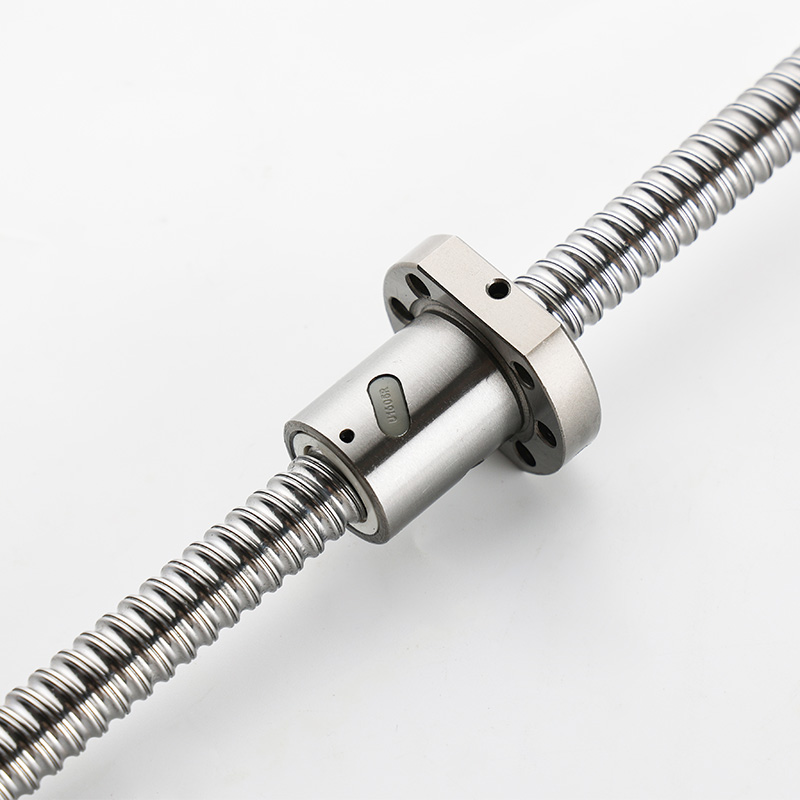
Choosing a Ball Screw introduces specific environmental considerations. Its sliding counterpart also presents unique maintenance requirements. Vertical orientations pose severe safety challenges. You must evaluate the physical operating environment carefully.
Vertical applications expose a critical safety vulnerability. Rolling friction is highly efficient. Because it exceeds 50 percent efficiency, it readily back-drives. If power loss occurs, gravity pulls the load downward. The nut forces the screw shaft to spin backward. The heavy payload will enter a dangerous free-fall.
Fail-safe mechanical brakes become absolutely mandatory here. You must install electromagnetic holding brakes on the motors. Lead threads behave entirely differently. Acme profiles possess low mechanical efficiency. They are inherently self-locking by design. Gravity alone cannot overcome the resting sliding friction. This makes them naturally safer for vertical lifting without power.
Recirculating bearings hate dirty environments. They fail rapidly if dirt or metal chips enter the ball tracks. Particulates destroy the smooth rolling surfaces. Bearings jam inside the internal return tubes. They require protective bellows and rigid wiper seals. You must also implement strict, frequent lubrication schedules.
Sliding polymer nuts thrive in harsh environments. Engineering plastics incorporate solid lubricants directly into their matrix. PTFE and molybdenum disulfide release slowly over time. They operate perfectly in dirty, dusty conditions. They also excel in medical clean-room environments. They eliminate the need for wet liquid lubricants entirely. Wet grease attracts abrasive dust. Dry polymer nuts avoid this problem completely.
Noise pollution matters in laboratory and office settings. Recirculating bearings generate distinct mechanical noise. The steel balls click as they enter and exit return tubes. High speeds amplify this rattling sound significantly. Sliding threads operate almost silently. The smooth rubbing action produces negligible acoustic output. Medical syringe pumps prefer sliding threads for this exact reason.
You need a clear path to shortlist your ideal drive mechanism. Analyzing the ball screw vs lead screw debate reveals clear winners. Different scenarios demand different mechanical solutions. Follow this framework to avoid costly engineering mistakes.
Select a rolling mechanism when your application requires maximum throughput. They dominate heavy industrial environments.
Continuous Operations: Choose them for 24/7 duty cycles. They handle constant motion without melting.
Dynamic Loads: Use them for high positional accuracy under heavy loads. They resist lateral deflection during milling.
High-Speed Actuation: Specify them for high-speed linear movements. Industrial machining centers rely on their rapid traverse capabilities.
Efficiency Priorities: Use them when battery power or motor size is strictly limited.
Select a sliding mechanism when your application prioritizes simplicity. They excel in specific niche environments.
Cost-Efficiency: Choose them when budgets remain tight. They offer excellent precision for lighter payloads.
Intermittent Movement: Use them for low duty cycles. They perform perfectly when resting between operational moves.
Vertical Safety: Specify them for vertical loads requiring self-locking features. They eliminate the need for expensive mechanical brakes.
Harsh Environments: Deploy them in particulate-heavy areas. Self-lubricating polymers survive where wet greasing is impossible.
The choice between rolling bearings and sliding threads requires careful analysis. It is rarely just about selecting "higher quality" parts. It is about matching the physical realities of friction, wear, and efficiency. You must align component capabilities to your specific operational criteria. Misalignment causes poor performance and early mechanical failure.
Take immediate action to secure your design parameters. First, calculate your true dynamic load and expected duty cycle. Second, consult manufacturer PV limits for sliding threads. Do not guess these thermal thresholds. Finally, request critical speed and buckling calculations before integration. Proper mathematical verification ensures your linear drive system operates flawlessly for years.
A: No, but they are closely related. A lead screw is the broad category for any sliding-friction threaded mechanism. Acme is a specific thread profile within that category. It features a trapezoidal shape with a 29-degree angle. This profile offers high strength and easier manufacturing compared to standard square threads.
A: Their lifespan depends entirely on the operating conditions. The polymer nut material, payload weight, and duty cycle dictate wear rates. Under light loads in 3D printers, they can last for years. If subjected to heavy, continuous industrial loads, the anti-backlash spring tension wears the soft nut down within months.
A: Yes, but it requires significant mechanical modifications. You face several integration challenges. You must resize your stepper motors due to different torque requirements. You need new flexible couplings to match different shaft diameters. Finally, recirculating nuts are physically larger. You must ensure you have enough physical clearance under your machine table.


