
- All
- Product Name
- Product Keyword
- Product Model
- Product Summary
- Product Description
- Multi Field Search
Views: 0 Author: Site Editor Publish Time: 2026-05-01 Origin: Site
Operating a Ball Screw assembly without proper lubrication is functionally equivalent to running a car engine without oil. Without a protective fluid barrier, internal components face immediate and severe friction. The hard truth is clear. Running a ball screw dry will reduce its expected operational lifespan by up to 90%. This lack of lubrication leads to rapid metal-on-metal degradation, increased backlash, and catastrophic binding inside the nut.
Many engineers mistakenly assume factory coatings are enough, but real-world operation demands ongoing maintenance. This guide breaks down the engineering reality behind ball screw lubrication. We will compare various lubricant types and map specifications to specific load profiles. You will also find detailed implementation standards to prevent premature equipment failure. By following these guidelines, you can ensure your linear motion systems perform accurately and reliably for years.
Ball screw assemblies strictly require active lubrication; factory-applied rust inhibitors are not functional lubricants.
The choice between oil and grease depends entirely on speed, temperature, and maintenance infrastructure.
Dry lubricants (like graphite or PTFE) and penetrating fluids (like WD-40) are actively detrimental to the rolling mechanisms of ball screws.
Baseline maintenance schedules require re-lubrication every 600–800 operational hours or 3–6 months, depending on load severity.
Many equipment operators believe sealed linear components require no ongoing maintenance. This is a dangerous misconception. So-called "zero-maintenance" seals merely extend the time between service intervals. They do not eliminate the need for fresh lubrication. Over time, internal grease degrades. It oxidizes, separates, and mixes with microscopic metal wear particles. If you ignore this reality, your equipment will inevitably fail. You must treat every linear motion assembly as an active maintenance point.
A microscopic lubrication film is the only thing preventing direct metal-to-metal contact. Without this film, the steel ball bearings grind directly against the tracks of the screw shaft. This extreme friction causes immediate surface scoring. Engineering data shows operating a dry ball screw reduces its lifespan to roughly 10% of its rated capacity. A component designed to last five years might fail in just six months.
When lubrication fails, the system undergoes several predictable breakdown stages. You should watch for these specific failure mechanisms:
Excessive heat generation: Friction generates rapid heat. The steel shaft undergoes thermal expansion. This expansion artificially increases the preload on the nut, leading to severe torque overload.
Rapid physical wear: Metal grinds away under load. This material loss causes increased backlash. The machine loses its positioning accuracy and repeatability.
Contaminant accumulation: Unlubricated tracks allow debris to gather freely. This debris enters the return tubes. Eventually, the accumulated particles cause physical jamming and lock the nut entirely.
You unbox a newly shipped component and notice a thin, slick coating on the shaft. It is crucial to understand this coating is merely a rust preventative. Manufacturers apply this very light oil strictly for shipping and storage protection. It is not a load-bearing operating lubricant. It will quickly burn off or get pushed aside during normal operation. You must apply a proper, application-specific lubricant before commissioning the machine.
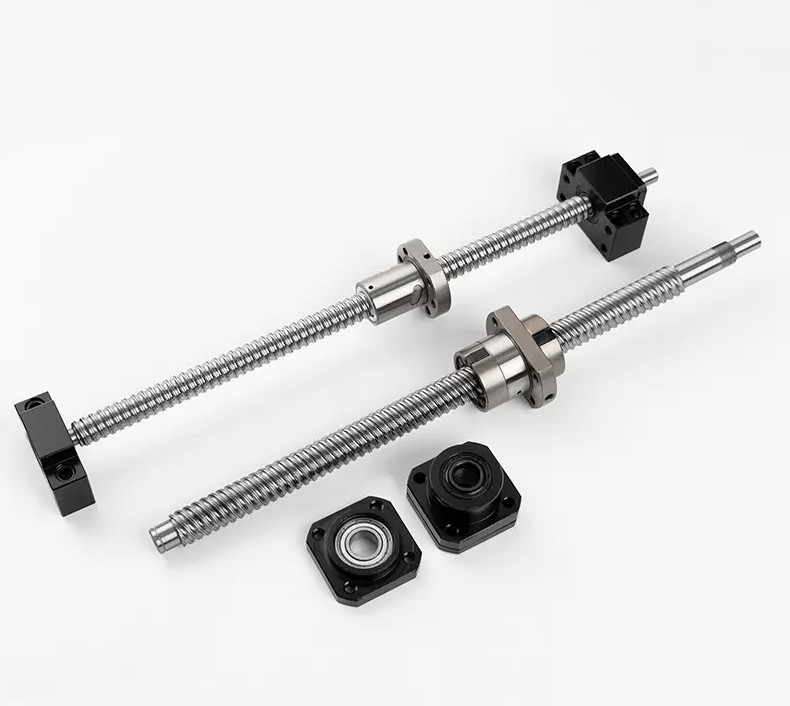
Neither oil nor grease is universally superior. The correct choice depends entirely on your application parameters. Speed, temperature, load, and your facility's maintenance infrastructure dictate the decision. You must evaluate what your machine requires and what your maintenance team can realistically support.
Oil provides excellent fluid dynamics for demanding applications. It offers unique benefits for highly specific machine environments.
Advantages: Oil provides excellent heat dissipation. As it flows through the nut, it carries heat away from the friction points. It also physically flushes away microscopic debris and moisture. This flushing action makes oil ideal for high-speed, continuous operations where heat buildup is a major concern.
Implementation Risks: Using oil requires costly external infrastructure. You will need pumps, metering systems, chillers, and filters. Furthermore, excess oil drips off the shaft. This runoff can contaminate adjacent processes, such as machining coolant or clean-room environments.
Grease is a suspension of oil inside a thickener. It is the most common choice for general industrial linear motion.
Advantages: Grease is highly cost-effective. The thickener keeps the lubricating oil trapped inside the nut much longer. This results in a much lower application frequency. Grease also tends to stay in place, meaning it rarely drips or contaminates process fluids below the machinery.
Implementation Risks: Grease is susceptible to physical buildup at the ends of the stroke. As the nut pushes excess grease, it forms thick clumps. If the machine lacks proper shielding, these clumps can trap abrasive dust. Additionally, incompatible grease bases (like mixing lithium and polyurea) can separate. The thickener hardens while the oil drains away, causing catastrophic failure.
Lubricant Type | Primary Benefit | Primary Drawback | Best Use Case |
|---|---|---|---|
Oil | Excellent heat dissipation and debris flushing | Requires complex pumping and filtering infrastructure | High-speed machining, continuous duty cycles |
Grease | Cost-effective and stays inside the nut longer | Can trap dust and build up at stroke ends | Heavy loads, low-to-medium speeds, general automation |
Engineers evaluate grease consistency using the NLGI (National Lubricating Grease Institute) penetration grades. The NLGI scale measures how soft or hard a grease is. The scale runs from fluid-like grades (000) up to solid block greases (6). For rolling contact bearings and linear motion systems, NLGI 2 is the most common baseline. It offers a balance of firmness and flow.
High-speed operations require minimal resistance. Thick grease will cause the ball bearings to plow through the fluid, generating unwanted heat.
For these applications, we recommend machine oil or a low-viscosity grease graded between NLGI 000 and NLGI 1. Your primary focus must be minimizing viscous drag. A lighter lubricant ensures the balls can roll freely without churning the grease. This keeps operating temperatures low and protects the return tubes from excess pressure.
Most standard factory automation falls into this category. The goal is to provide a durable film that does not leak out of the seals.
We recommend standard NLGI 1 or NLGI 2 grease for medium profiles. Your focus here is maintaining a consistent, smooth film across the entire length of the screw shaft. The grease should adhere well to the steel but remain soft enough to circulate through the ball return circuits without dripping onto the floor.
Heavy loads exert massive pressure on the tiny contact points between the balls and the thread tracks. Standard grease will squeeze out under this pressure, allowing metal-to-metal contact.
We highly recommend grease formulated with EP2 (Extreme Pressure) additives. These chemical additives bond with the steel surface to prevent metal scoring under severe stress. Note: EP2 additives may naturally give the steel shaft a dull, dark appearance over time. This visual change is completely normal. It is a byproduct of the chemical bonding process and is not a sign of failure.
Many common maintenance shop chemicals will actively destroy a Ball Screw. You must train your maintenance staff to avoid the following detrimental practices.
Using Dry Lubricants (PTFE, Graphite, Molybdenum Disulfide): The physics of linear motion relies heavily on rolling friction. The ball bearings need a microscopic amount of traction to roll smoothly through the tracks. Dry lubricants reduce friction so severely that they eliminate this traction. Consequently, the bearings begin to slide or skid rather than roll. This skidding action grinds flat spots onto the balls and rapidly damages the precision ball tracks.
Applying Penetrating Fluids (WD-40): Penetrating solvents are not load-bearing lubricants. They act as degreasers. If you spray WD-40 onto a linear motion assembly, it will rapidly strip away the existing protective grease. The fluid will quickly evaporate, leaving the bare metal entirely unprotected against friction and moisture.
Using Compressed Air for Cleaning: You should strongly warn your team against using high-pressure air hoses to blow dust off the machinery. Compressed air forcefully drives abrasive chips, fiberglass, and metallic dust directly past the nut wipers. This pushes contaminants deep into the bearing tracks and return tubes. Always use an industrial vacuum system to clean the area instead.
Consistent timing is the foundation of mechanical reliability. You should establish an industry-standard baseline for your maintenance team. The universal rule-of-thumb is to relubricate the assembly every 600 to 800 hours of active operation. If you track maintenance by the calendar, plan for service every 3 to 6 months. Use the 3-month interval for heavy loads and dirty environments. Use the 6-month interval for normal loads in clean environments.
Load Severity | Operating Environment | Recommended Service Interval |
|---|---|---|
Normal / Light | Clean room or enclosed machine | 800 hours / 6 months |
Medium | Standard factory floor | 600 hours / 4 months |
Heavy / Extreme | High dust, heavy shock loads | 400 hours / 3 months |
You cannot simply pump new grease over old, contaminated grease. Hardened grease acts as a dam inside the nut. Applying new pressure behind it causes destructive buildup and can blow out the end seals. You must flush the nut with a mild, approved solvent first. Wipe the screw shaft completely clean with a lint-free cloth. Only after the old, oxidized grease and trapped debris are gone should you proceed with reapplication.
Proper application ensures the entire internal circuit receives protection. Lubricant should be applied evenly to the shaft's outer diameter or injected directly via the designated lube fitting on the nut body. Crucially, applying the grease is only the first step. The machine must then be "jogged." You must run the nut back and forth along the full stroke of the shaft several times at a slow speed. This manual jogging pulls the lubricant fully into the ball nut circuits, coating every bearing evenly.
Certain applications require the nut to move only tiny distances back and forth continuously. Engineers call this "dithering." In these short-stroke, highly repetitive micro-movements, the lubricant never completes a full circulation through the return tubes. The balls rock back and forth in the exact same spot, pushing all the grease away. This leads to localized indentation and severe wear known as brinelling.
To mitigate this, you must mandate a programmed "full-stroke" run periodically. Have the software command the machine to travel its entire length once every few hours. This long movement redistributes the grease over the balls and prevents localized track damage.
The final verdict is absolute. Your equipment's longevity is entirely dependent on a strict, load-appropriate lubrication regimen. Skipping maintenance intervals or using the wrong fluids guarantees catastrophic mechanical failure. Precision motion systems require disciplined oversight to function as designed.
Advise your engineering and maintenance teams to audit their current machines immediately. They need to verify whether they are mistakenly using sliding-friction lubes on rolling-friction components. You should also audit your existing preventive maintenance software to establish a rigid 600-hour inspection baseline. Taking these proactive steps ensures smooth operation, preserves component accuracy, and prevents sudden, catastrophic downtime.
A: No. That is a rust preventative for shipping and storage, not a load-bearing operating lubricant. It lacks the film strength necessary to prevent metal-on-metal friction under operational loads. You must apply an appropriate grease or oil before use.
A: The screw shaft should feel slick to the touch with a thin film, but it should never drip or form thick, visible clumps at the end of the nut's travel. Excessive grease buildup traps dirt and can blow out the internal seals.
A: Uneven torque is typically the first sign of contamination or hardened grease blocking the ball return circuits. It requires an immediate solvent flush and relubrication, not just adding more grease on top. Forcing movement will permanently damage the tracks.


