
- All
- Product Name
- Product Keyword
- Product Model
- Product Summary
- Product Description
- Multi Field Search
Views: 168 Author: Site Editor Publish Time: 2026-04-04 Origin: Site


Ball nuts are critical components in precision linear motion systems, providing reliable conversion of rotational motion into linear motion. These components are widely used in CNC machines, robotics, industrial automation, and aerospace equipment. While ball screws are often highlighted for precision and load handling, the design of the ball nut itself plays an equally important role in determining efficiency, load capacity, rigidity, and overall system reliability.
In the machinery industry, two main types of ball nuts dominate the market: flanged ball nuts and standard ball nuts. Understanding the differences between these types is essential for engineers, machine designers, and manufacturers seeking optimized performance, long-term durability, and minimal maintenance requirements. This article explores structural distinctions, performance characteristics, installation considerations, material selection, maintenance strategies, applications, innovations, and how choosing the right type can impact efficiency and load capacity.
A ball nut is a mechanical assembly containing multiple rolling elements—typically hardened steel or ceramic balls—that circulate along the grooves of a corresponding ball screw shaft. When the screw rotates, the balls roll along precisely machined paths, converting rotational motion into smooth, linear movement.
The ball nut serves three critical functions:
Transmitting load efficiently from the screw to the linear motion system.
Reducing friction, thanks to rolling contact, which improves energy efficiency and reduces wear.
Maintaining precision, ensuring consistent movement even under high loads or rapid motion.
Because of these functions, the design of the ball nut directly influences system accuracy, reliability, and lifespan.
Standard ball nuts, also called cylindrical or non-flanged ball nuts, are simple, compact, and highly versatile. Their key features include:
Cylindrical body without an integrated mounting flange.
Requires external mounting hardware or housing for installation.
Compact form factor suitable for space-constrained machinery.
Can be customized for non-standard applications or retrofitted into existing systems.
Standard ball nuts offer flexibility in installation and are often easier to integrate into machinery with limited space. They are suitable for applications where precise mounting blocks can be designed or adjusted according to specific requirements.
Without a flange, these nuts rely heavily on external support for rigidity. Misalignment or uneven load distribution can reduce performance, cause premature wear, or lead to vibration issues at high speeds.
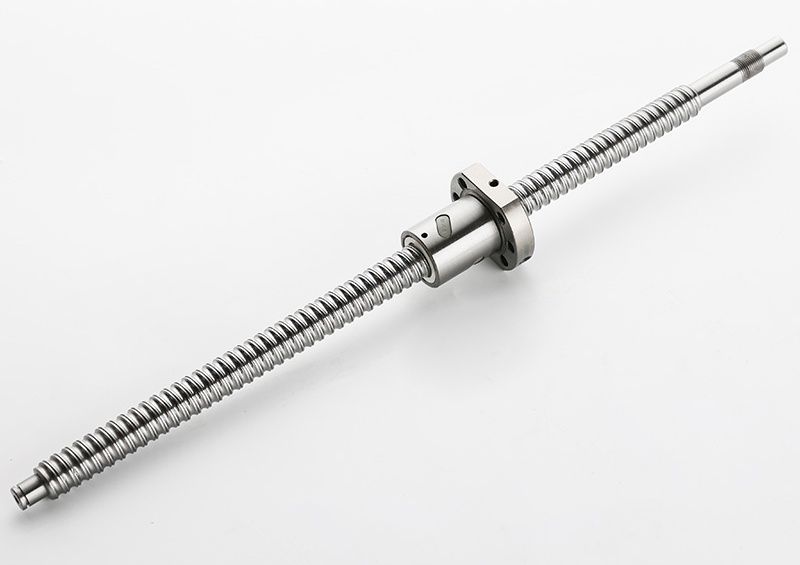
Flanged ball nuts include an integrated flange with pre-drilled mounting holes, providing direct attachment to a machine frame or housing.
Integrated flange ensures secure mounting.
Distributes load over a wider area, improving rigidity.
Simplifies installation by reducing the need for separate mounting components.
Suitable for high-precision and high-load applications.
Flanged ball nuts reduce installation complexity and increase system rigidity, resulting in more stable and accurate linear motion. They are ideal for CNC machines, robotic actuators, and automated production lines where high load-bearing and minimal backlash are critical.
Flanged nuts are slightly larger, which may limit their use in extremely compact or constrained designs. They also add a small amount of additional mass, which may be a consideration in high-speed applications.
Comparison Aspect | Standard Ball Nuts | Flanged Ball Nuts |
Mounting Configuration | Require separate mounting blocks, brackets, or adapters. They are flexible, but installation must be precise to avoid misalignment. | Use the integrated flange for mounting, ensuring consistent alignment and stability. This simplifies assembly and reduces the risk of improper installation. |
Load Distribution | Load is transmitted through the nut body to external supports. Uneven or misaligned mounts can create stress concentrations. | Load is spread evenly across the flange, enhancing axial and radial load capacity and reducing potential deflection. |
Space Considerations | Compact and flexible, suitable for machinery with tight spatial constraints. | Larger due to the flange, but provide higher stability and ease of alignment. |
Flanged ball nuts typically offer superior rigidity because the flange creates a secure interface with the machine frame. Preloaded flanged ball nuts virtually eliminate backlash, ensuring repeatable precision even under varying loads. Standard nuts can achieve similar precision, but their performance depends on the quality of external mounting and alignment.
The design of a ball nut affects how much axial and radial load it can support:
Axial Load: Flanged designs distribute axial loads more evenly.
Radial Load: Flanged nuts resist lateral forces better due to the wider mounting area.
Dynamic Load: Both types can handle dynamic motion, but flanged nuts maintain stability under high-speed operation.
Rolling contact between balls and threads minimizes friction. While both standard and flanged ball nuts benefit from low friction, flanged nuts often provide better alignment and reduced bending stress on the screw, indirectly improving efficiency.
The material used for the nut body and balls significantly affects efficiency, load capacity, and durability.
Hardened Steel: High load-bearing capacity and durability for industrial applications.
Stainless Steel: Corrosion resistance for medical, food, and chemical environments.
Ceramic Balls: Reduce weight, friction, and wear in high-speed systems.
Polymers or Coatings: Enhance self-lubrication, reduce maintenance, and improve smoothness.
Material selection is especially important in high-load or high-precision applications, where failure could lead to costly downtime.
Preloading a ball nut reduces backlash and increases system stiffness:
Single-Nut Preload: Internal tension reduces free play.
Double-Nut Preload: Two nuts pressed together eliminate backlash completely.
Spring or Elastic Preload: Maintains contact under dynamic conditions, reducing vibration.
Properly designed preload improves linear motion accuracy, stability, and load handling, particularly in flanged designs where the mounting flange enhances rigidity.
Flexible mounting options, including custom brackets or housing.
Alignment is critical to prevent wear and misalignment.
Ideal for retrofits or designs with limited space.
Integrated flange simplifies mounting and ensures consistent alignment.
Reduces installation time and complexity.
Ideal for high-load, high-precision applications requiring minimal backlash.
CNC Machines: High precision under heavy cutting loads.
Robotics: Accurate positioning in robotic actuators.
Automation Lines: Linear actuators in assembly or packaging lines.
Medical Devices: Imaging or surgical equipment requiring high accuracy.
Compact Equipment: Fits in tight spatial configurations.
Custom Machinery: Flexible for specialized applications.
Retrofits: Replaces existing components without redesigning mounts.
Proper maintenance ensures long-term performance:
Lubrication: Regularly apply appropriate grease to rolling elements.
Inspection: Check for wear, cracks, or misalignment.
Cleaning: Remove dust, debris, and contaminants.
Alignment Checks: Ensure screw and nut are parallel to reduce uneven wear.
Flanged ball nuts simplify maintenance by providing a rigid mounting interface that minimizes misalignment and uneven loading.
Modern ball nut technology has seen innovations:
Hybrid Ceramic Balls: Lighter, lower friction, and resistant to wear.
Low-Friction Coatings: Extend lifespan and reduce maintenance.
Integrated Sensors: Monitor preload, temperature, and wear for predictive maintenance.
Compact, High-Load Designs: Optimized geometry increases capacity while minimizing footprint.
These innovations improve performance, reliability, and efficiency for industrial applications.
For manufacturers seeking high-performance ball nuts, sourcing quality materials is critical. PRIO provides premium polymer and metal solutions for flanged and standard ball nuts, enhancing durability, efficiency, and precision. Using trusted suppliers ensures components withstand heavy loads, high-speed operation, and demanding industrial environments. Partnering with reliable material providers reduces downtime, maintenance costs, and improves overall productivity.
Flanged and standard ball nuts serve distinct purposes in machinery:
Flanged Ball Nuts: Offer high rigidity, simplified mounting, and better load distribution. Ideal for heavy-duty, high-precision applications.
Standard Ball Nuts: Compact, flexible, and adaptable to tight spaces or custom configurations.
Both types benefit from material quality, proper preload, lubrication, and alignment. Understanding these differences is essential for engineers and manufacturers seeking to optimize linear motion systems for efficiency, load capacity, and long-term performance.
For businesses or individuals seeking premium materials and components for ball nuts, PRIO offers high-quality solutions that ensure durability, precision, and reliable operation in machinery applications.
Q: What is the main difference between flanged and standard ball nuts?
A: Flanged ball nuts have an integrated mounting flange that simplifies installation and improves load distribution, while standard ball nuts require external mounting.
Q: Which type of ball nut is better for high-load applications?
A: Flanged ball nuts provide superior rigidity and distribute axial and lateral loads more effectively.
Q: Can standard ball nuts be used in compact machinery?
A: Yes, their smaller size and flexible mounting make them ideal for space-constrained applications.
Q: How does ball nut design impact maintenance requirements?
A: Flanged nuts reduce misalignment and stress on components, simplifying maintenance, whereas standard nuts require careful mounting and alignment checks.


