
- All
- Product Name
- Product Keyword
- Product Model
- Product Summary
- Product Description
- Multi Field Search
Views: 166 Author: Site Editor Publish Time: 2026-07-27 Origin: Site
Excessive noise in a linear motion system is rarely just an acoustic nuisance. It is often a leading indicator of mechanical degradation, suboptimal specification, or impending failure. When you manage high-speed industrial applications, mitigating this noise requires moving beyond temporary fixes. You must address the root mechanical mechanics driving the vibration. Left unchecked, resonant frequencies can compromise positional accuracy and accelerate component wear.
Reducing Ball Screw noise involves balancing rotational speed, evaluating recirculation architecture, managing system rigidity, and optimizing dampening mechanisms. This guide outlines verifiable, engineering-led strategies to help you diagnose vibration sources effectively. You will learn how to specify components minimizing acoustic emissions without compromising load capacity. By following these methods, you can build quieter, more reliable linear motion assemblies.
Acoustic Profiling: Identify the root cause by mapping sound characteristics—clicking indicates recirculation collisions, chattering points to raceway imperfections, and squeaking signals alignment errors.
Speed Reduction via Lead Optimization: Applying the empirical noise formula $\text{Noise} \propto \log(dm \times n)$, engineers can significantly drop operating noise by increasing the thread lead to reduce RPM while maintaining linear speed.
Component Specification: Upgrading to deflector-style high-speed nuts, utilizing radial anti-backlash mechanisms, or alternating nylon and steel balls can structurally dampen vibration.
System-Level Mitigation: Modern lightweight machine bases amplify resonance; addressing noise requires a holistic approach that includes high-viscosity damping lubrication and critical speed management.
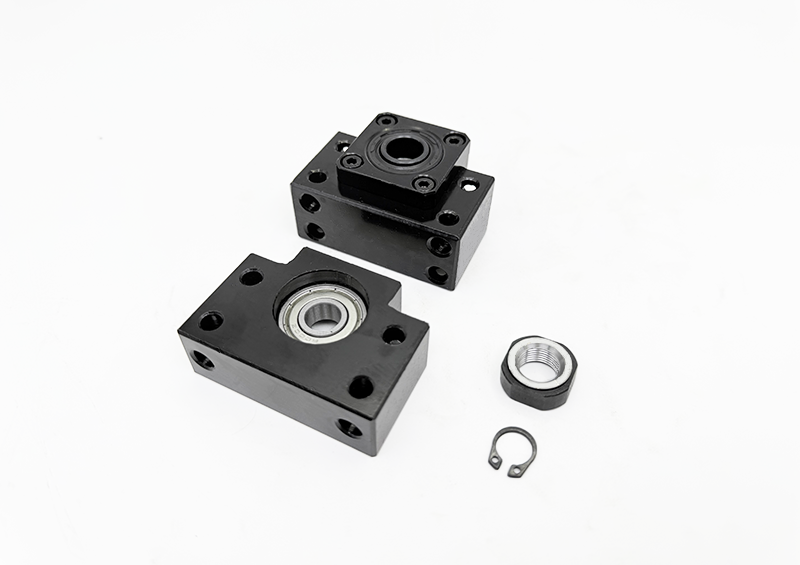
Before altering specifications, it is critical to diagnose the precise origin of the vibration. Ball screw noise typically stems from distinct physical interactions. Isolating the sound profile prevents misdirected maintenance efforts.
This noise occurs when ball bearings exit the raceway and collide within the return tubes. It is inherent to traditional designs. However, it becomes hazardous if the noise turns erratic. Erratic clicking strongly indicates damaged balls or internal debris. You should inspect the nut immediately if this acoustic pattern emerges.
Micro-ripples or surface roughness on the screw grooves cause raceway chatter. The rolling bearings interact against these imperfections, generating high-frequency vibrations. This specific frequency often excites resonance in lightweight machine frames. You will hear this as a systemic hum echoing through the machine chassis.
Squeaking is usually symptomatic of dynamic friction imbalances. Engineers call this slip-stick behavior. It also points to severe mechanical misalignment. Bending in the shaft forces abnormal sliding rather than rolling. Concentricity errors between the shaft and the nut produce similar binding noises. You must check your mounting tolerances if squeaking occurs.
Not all noise indicates failure. A baseline hum is entirely normal for high-speed recirculation. Intervention is strictly required when noise couples with other symptoms. Watch for an increase in backlash. Monitor the system for inconsistent torque requirements. Check if operating temperatures exceed baseline parameters. If these align with abnormal noise, you must intervene.
Acoustic Diagnostic Reference Table
Sound Profile | Primary Mechanical Cause | Recommended Action |
|---|---|---|
Clicking / Clacking | Recirculation collisions or trapped debris | Inspect return tubes; flush and relubricate nut. |
Humming / Buzzing | Raceway surface roughness; frame resonance | Check machine base rigidity; evaluate raceway finish. |
Squeaking / Grinding | Slip-stick friction; shaft misalignment | Realign mounting blocks; verify concentricity. |
The most effective method for noise reduction occurs at the design and specification stage. Speed optimization directly targets the mathematical root of the problem.
Industry empirical data demonstrates a clear mathematical relationship. Noise is directly proportional to the logarithm of the ball diameter multiplied by the rotational speed. Engineers express this as $\log(dm \times n)$. To lower the noise, you must lower the inputs. Since altering the ball diameter ($dm$) affects load capacity, reducing rotational speed ($n$) is usually the safest target.
To reduce rotational speed ($n$) without sacrificing linear throughput, engineers should evaluate screws utilizing a larger lead. A larger lead achieves the same linear travel per minute. It does so requiring significantly fewer shaft rotations. This directly suppresses acoustic output.
RPM vs. Lead Comparison Chart
The following HTML chart illustrates how increasing the lead drastically cuts the required RPM for a constant linear speed of 1000 mm/min. Lower RPM directly yields lower noise.
Target Linear Speed | Screw Lead | Required RPM | Acoustic Impact |
|---|---|---|---|
1000 mm/min | 5 mm | 200 RPM | High Recirculation Noise |
1000 mm/min | 10 mm | 100 RPM | Moderate Recirculation Noise |
1000 mm/min | 20 mm | 50 RPM | Low Recirculation Noise |
Operating too close to the system’s natural frequency causes severe resonance. As rotational speed climbs, the shaft begins to whip. Best practices dictate a strict safety boundary. Maximum application RPM should never exceed 85% of the screw’s first-order critical speed. Surpassing this limit guarantees a dramatic spike in noise and potential catastrophic bending.
The design of the ball nut dictates how smoothly the bearings recirculate. When specifying replacements or upgrading high-noise systems, you must evaluate structural differences. A well-designed Ball Screw nut manages kinetic energy better.
Traditional external return tubes force balls through abrupt directional changes. The balls hit the tube walls hard. This creates distinct collision noise. High-speed, low-noise ball nuts utilize internal deflectors instead. End-cap returns serve a similar function. They provide a much smoother, tangential pickup path for the balls. This tangential path effectively eliminates high-impact recirculation clatter.
Excessive axial play allows balls to rattle under varying loads. Specifying an appropriate anti-backlash nut stabilizes the load. It removes the free space causing the rattle. Furthermore, radial clearance elimination mechanisms often outperform traditional axial spring-loading. Radial systems dampen vibration better. They also maintain smoother rotational dynamics under heavy acceleration.
Best Practices for Nut Specification: Always match the internal recirculation style to your application speed. If you operate above 2000 RPM, mandate internal deflectors over external tubes.
Altering the physical properties of the rolling elements can interrupt vibration transmission. Modifying surrounding materials works similarly. You can absorb acoustic energy before it amplifies.
A proven customization for severe noise is alternating standard steel balls with nylon spacer balls. Polymer balls work equally well. The nylon balls act as internal dampeners. They prevent metal-to-metal collisions between adjacent bearings as they crowd into the return circuit.
Implementation Risk: This strategy drastically reduces the overall dynamic load capacity. Often, the capacity drops by up to 50%. Only the steel balls carry the primary mechanical load. You should only use this method where the system is significantly over-specified for the required thrust.
For environments prioritizing noise reduction under moderate loads, alternative materials excel. You might evaluate self-lubricating polymer or PEEK lead screws. These advanced polymers drop the friction coefficient significantly. They reduce the delta between static and dynamic friction. This virtually eliminates "slip-stick" vibrations.
For high-load steel assemblies, consider highly polished raceways. Chrome-plated grooves minimize the micro-chatter associated with rough surface finishes. Smoother rolling elements generate quieter motion.
Steps for Custom Material Implementation
Assess Load Margin: Calculate your current dynamic load. Ensure you have at least a 200% safety margin before switching to alternating nylon balls.
Select Spacer Material: Choose high-grade nylon or polyacetal for spacer balls to maximize acoustic absorption.
Evaluate Surface Finish: Specify a ground raceway finish instead of a rolled finish for superior micro-roughness control.
Monitor Run-in Period: Run the newly configured assembly at 50% speed for the first 10 hours to allow bearings to seat quietly.
Lubrication in a Ball Screw serves a dual purpose. It reduces friction, naturally. But it also acts as a physical acoustic dampener. Fluid dynamics play a massive role in acoustic management.
Transitioning to a heavier, more viscous grease creates a thicker hydrodynamic film. As balls circulate, this thick film absorbs mechanical shock. It cushions the steel bearings as they strike the deflectors. It also acts as a buffer against raceway resonance. Think of it as a microscopic shock absorber distributed throughout the nut.
For high-automation environments, standard grease packing is often inefficient. Automated oil-air micro-lubrication systems provide a better solution. They ensure a continuous, uniform film thickness. This constant delivery prevents dry-running conditions. Dry grooves cause sudden spikes in friction chatter. Oil-air systems maintain optimal dampening constantly.
Airborne contaminants act as abrasives. Dust and metal shavings entering the nut fundamentally alter the raceway geometry. Over time, these abrasives carve micro-pitting into the steel. Pitting generates immense noise. Proper specification of heavy-duty wipers is a mandatory preventative measure. Bellows or telescopic covers protect the shaft geometry. Long-term acoustic control depends entirely on keeping the raceway pristine.
Common Mistakes: Do not over-pack the nut with grease hoping to silence it. While thicker grease dampens sound, excess volume traps heat. It drastically increases running torque and can cause premature failure.
Reducing ball screw noise requires a systematic audit of the linear motion assembly. For existing machines, transitioning to high-viscosity damping greases provides a fast mechanical improvement. Verifying shaft alignment also yields immediate acoustic benefits.
Diagnose the sound first. Differentiate between recirculation clicking and frame resonance humming.
Address the fundamental mathematics of the system by prioritizing larger leads. This safely lowers operational RPMs.
Specify deflector-style internal return nuts for high-speed applications to eliminate collision clatter.
Strictly manage critical speed thresholds. Never exceed 85% of the first-order limit.
Balance acoustic dampening goals against necessary load capacities, especially when considering alternating nylon ball configurations.
Applying these engineering principles ensures a robust, reliable, and quiet mechanical system.
A: Not inherently. High-speed recirculation generates baseline noise. However, if the noise profile changes suddenly, becomes a high-pitched squeal, or is accompanied by increased heat and loss of positional accuracy, it indicates critical wear, contamination, or loss of lubrication.
A: While a thicker grease acts as a vibration damper, simply over-packing the nut is detrimental. Over-lubrication increases running torque, traps heat, and can cause the system to overheat at high speeds. Lubricant volume must remain within manufacturer specifications.
A: Alternating steel and nylon spacer balls prevents metal-to-metal clashing, drastically lowering noise. However, because the nylon balls do not bear the primary mechanical load, the ball screw's overall dynamic load capacity is effectively cut in half.
A: Modern lightweight machine bases lack the mass to absorb mechanical vibrations. What was previously an inaudible raceway vibration in a heavy cast-iron frame can easily match the resonant frequency of a lighter aluminum frame, amplifying the ball screw noise into a loud, systemic hum.
A: Yes. Sliding contact lead screws (especially those utilizing engineered polymers like PEEK or Polyacetal) do not have recirculating metal balls, making them acoustically superior. However, they operate with higher friction, lower efficiency, and stricter speed limitations compared to ball screws.


