
- All
- Product Name
- Product Keyword
- Product Model
- Product Summary
- Product Description
- Multi Field Search
Views: 0 Author: Site Editor Publish Time: 2026-08-15 Origin: Site
Engineers constantly face a difficult balancing act. You must weigh the upfront cost of linear motion components against the operational demand for exact positioning, stiffness, and repeatability. Upgrading your mechanics is rarely just a simple parts swap. It represents a system-level investment. Your component choice directly dictates motor sizing, overall cycle times, and machine lifespan. Using an underperforming part jeopardizes your entire automated system.
This article provides a rigorous look at the distinct performance benefits of these components. We will explore implementation realities and selection criteria for high-precision variants compared to standard options. You will learn exactly how to match the right precision grade to your specific payload requirements. By understanding these mechanical nuances, you avoid costly over-speccing while guaranteeing optimal automated performance. Let us examine the data.
High precision ball screws deliver 90%+ mechanical efficiency and sub-micron motion accuracy, significantly outperforming standard lead screws.
Upgrading enables the use of smaller drive motors and reduces long-term maintenance cycles in demanding environments.
Selecting the right precision grade (e.g., Ground C3 vs. Rolled C7) requires aligning component capabilities with specific business outcomes and payload requirements.
Proper installation, alignment, and lubrication are non-negotiable to realize the ROI of a precision-grade component.
Selecting the correct linear motion mechanism requires understanding the mechanical baseline of available technologies. Engineers often evaluate lead screws, standard rolled ball screws, and high-precision variants. Each category offers distinct physical characteristics. These characteristics dictate their appropriate application environments.
The limitation of lead screws: Lead screws rely on sliding friction. A polymer or bronze nut slides directly over the screw threads. This sliding contact generates significant friction. High friction translates to rapid heat generation during continuous duty cycles. Consequently, lead screws suffer from rapid wear under heavy loads. They require more motor torque to overcome the initial static friction. While cost-effective for simple, low-speed applications, they fail in high-cycle automated environments.
The standard ball screw capability: A standard Ball Screw replaces sliding friction with rolling contact. Steel balls recirculate inside the nut. This rolling action boosts mechanical efficiency above 90 percent. Standard rolled threads handle high speeds and heavy loads efficiently. However, the cold-rolling manufacturing process leaves microscopic dimensional variations. Standard rolled threads often lack the tight tolerances required for exact, repeatable positioning in advanced robotics.
The high-precision differentiator: High-precision variants utilize ground threads or advanced precision-rolled threads. Manufacturers grind the threads after heat treatment. This removes distortions and achieves exacting lead accuracy. These components feature custom preload configurations. Engineers design them specifically to eliminate internal clearance, commonly known as backlash. This structural rigidity maintains exact positioning under dynamic, shifting loads.
Baseline Comparison of Linear Motion Screws
Component Type | Contact Method | Efficiency | Backlash Profile | Ideal Use Case |
|---|---|---|---|---|
Lead Screw | Sliding Friction | 30% - 50% | High (unless heavily preloaded) | Low-speed, light-duty adjustment |
Standard Rolled Screw | Rolling Friction | > 90% | Moderate to Low | General automation, packaging |
High-Precision Ground Screw | Rolling Friction | > 90% | Zero (Custom Preload) | CNC machining, aerospace, medical |
Upgrading to a superior tolerance grade unlocks distinct mechanical advantages. These advantages ripple through the entire machine architecture. They improve end-product quality and streamline operational efficiency.
Precision systems require tight lead error tolerances. Lead error measures the deviation between the theoretical travel distance and the actual travel distance per revolution. Ground threads adhere to stringent ISO/DIN tolerance classes, such as C3 or C5. Tighter tolerances translate directly to exact positioning. Sub-micron motion accuracy becomes achievable and repeatable. In manufacturing environments, this reduces scrap rates. In automated testing processes, it provides higher fidelity and reliable data collection.
Rolling contact minimizes energy loss. Minimal friction allows for smooth power transfer from the drive motor to the load. They ensure precision transmission across the entire stroke length. Because efficiency routinely exceeds 90 percent, engineers face lower torque requirements. You can specify smaller, more cost-effective servo motors and drives. Smaller motors draw less power. They also generate less heat, stabilizing the electrical cabinet temperature.
Industrial reliability relies on calculable longevity. Engineers use the L10 life metric to predict when 10 percent of identical components will show signs of fatigue. High-precision units excel here.
Precise Pathways: Accurately ground raceways distribute loads evenly across all active ball bearings.
Preloading: Oversized balls or dual-nut configurations eliminate axial play. This creates immense structural rigidity.
Deflection Resistance: High rigidity prevents shaft deflection during rapid acceleration.
This calculated service life minimizes unplanned downtime. It allows maintenance teams to schedule replacements during planned facility outages.
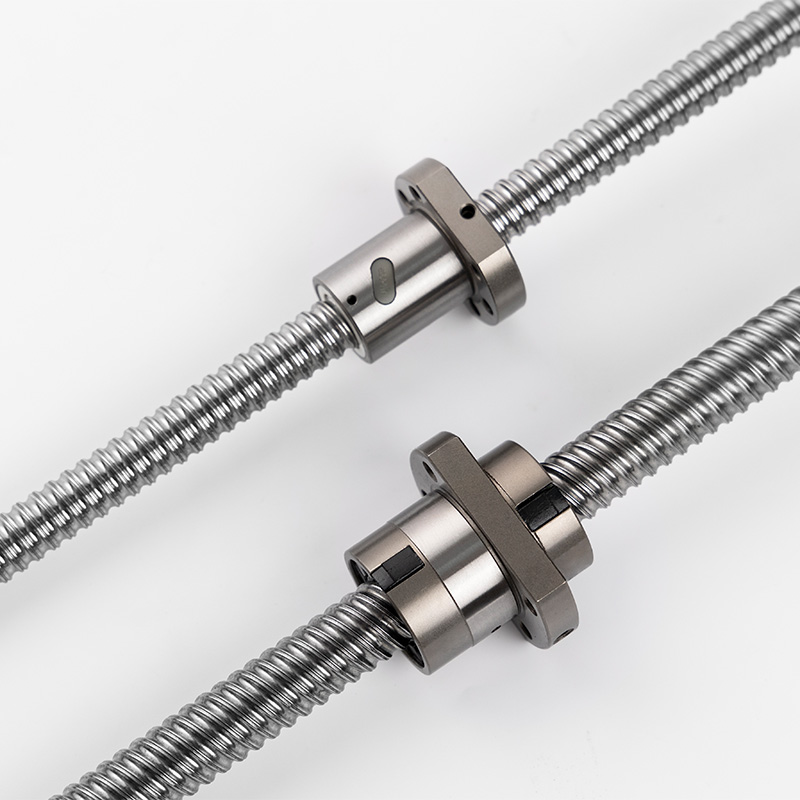
Certain industries cannot function without strict tolerance controls. In these sectors, standard linear components simply fail to meet baseline production requirements.
Metal cutting operations generate severe, multidirectional forces. A 5-axis CNC mill requires extreme axial stiffness to withstand these heavy cutting forces. If the tool axis shifts even slightly, the surface finish degrades. A dedicated machine tool screw provides this necessary stiffness. High-precision variants eliminate "lost motion" during sudden direction reversals. This guarantees flawless interpolation during complex contour machining.
Wafer fabrication and medical device assembly occur inside strict cleanrooms. These environments demand ultra-smooth, vibration-free movement. Vibrations disturb microscopic alignments in semiconductor lithography. High-precision units win here because they offer predictable friction torque. They integrate specialized low-particulate lubrication options. These unique greases prevent airborne contamination while ensuring microscopic positioning.
Application Requirement Matrix
Application Sector | Primary Engineering Challenge | Precision Screw Solution |
|---|---|---|
CNC Machining | Vibration and cutting force deflection | Heavy preload, C3 ground threads |
Semiconductor Handling | Particulate contamination, jitter | Low-friction torque, vacuum-compatible grease |
Medical Imaging (MRI/CT) | Acoustic noise, jerky motion | Precision rolled C5, optimized ball return tubes |
Automated Optical Inspection | Exact camera positioning, fast settling time | Zero backlash dual-nut design |
Specifying a top-tier component guarantees nothing if the surrounding mechanical architecture is flawed. Engineers must navigate several implementation hurdles.
There is a transparent price delta between C3/C5 ground grades and C7/C10 rolled grades. Ground units cost significantly more due to extended manufacturing and inspection times. You must not pay for precision your application framework cannot support. If your machine frame flexes under load, a C3 grade component will not improve your final product quality. Match the screw's tolerance to your frame's structural rigidity.
When mounting a high precision ball screw, angular misalignment is fatal. These rigid components are entirely unforgiving of poor mounting practices.
Risk: Misalignment forces the nut to bind against the shaft. This creates intense localized pressure, leading to premature raceway spalling.
Solution: You must utilize precision-machined mounting surfaces. Use high-quality angular contact support bearings. Align the motor, coupling, and bearing blocks using dial indicators.
Metal-to-metal contact destroys ground raceways instantly.
Risk: Starving the nut of lubrication degrades positional accuracy rapidly. Using the wrong oil viscosity prevents the formation of a protective hydrodynamic film.
Solution: Design automated lubrication systems directly into the machine architecture. Plumb oil or grease lines directly to the nut housing. Program the PLC to dispense lubricants based on travel distance, not just time.
Do not open a manufacturer catalog without defining your mathematical baseline. Follow a strict evaluation framework to specify the correct component.
Define the success criteria: First, map out the exact payload weight. Calculate the maximum travel speed and the required positional resolution. Determine the duty cycle percentage. You need these figures to calculate the required dynamic load rating.
Preload selection: Balance your operational needs. A heavier preload completely removes internal clearance. This gives you zero backlash. However, heavier preloads increase internal friction. This friction generates excess heat at high speeds. Select a light preload (e.g., P1) for high-speed automated lines. Select a heavy preload (e.g., P3) for heavy-duty metal cutting.
Consulting the manufacturer: Off-the-shelf options rarely fit high-end applications perfectly. Move past standard catalog items. Request custom end-machining to fit your specific bearing blocks. Ask for specific nut configurations to fit tight envelopes. Negotiate tailored pitch and lead ratios to optimize your servo motor's RPM band.
High-precision linear components dictate the success of advanced automated processes. They are foundational elements for systems requiring absolute accuracy, mechanical efficiency, and long-term reliability.
Upgrading removes sliding friction, boosting mechanical efficiency above 90 percent.
Sub-micron positioning eliminates lost motion and reduces manufacturing scrap rates.
Strict adherence to installation tolerances prevents premature raceway failure.
Proper lubrication strategies maintain the protective film, guaranteeing the L10 calculated lifespan.
Your surrounding machine architecture must support these tight tolerances to realize the full mechanical return on investment. Take the next step in your design process. Download a 3D CAD model for your assembly layout. Utilize an online manufacturer sizing calculator to verify your L10 life projections. Finally, contact a dedicated application engineering team for a specific, verified load-life calculation tailored to your machine's exact duty cycle.
A: The difference lies in the manufacturing method. Precision ground variants are machined using abrasive grinding wheels after heat treatment. This process removes distortions, achieving exceptional C3 or C5 tolerance classes. Precision rolled variants are cold-formed through pressure dies. Rolling is faster and cheaper, resulting in C7 or C10 tolerances. Ground units cost more but provide superior lead accuracy for exacting applications.
A: Preloading removes internal clearance, known as backlash, between the nut and the screw shaft. Manufacturers achieve this by inserting slightly oversized balls into the raceway or by using a dual-nut setup forced apart by a spacer. This internal tension increases structural rigidity. High rigidity prevents the nut from shifting under varying axial loads, ensuring exact, repeatable positioning upon direction reversal.
A: No. Proper lubrication is a strict, non-negotiable requirement. Oil or grease creates a microscopic protective film between the steel balls and the raceways. Operating without lubrication causes immediate metal-to-metal contact. This friction generates extreme heat, causing micro-welding and spalling. Without a protective film, the component will suffer rapid, irreversible accuracy loss and catastrophic mechanical failure.


