
- All
- Product Name
- Product Keyword
- Product Model
- Product Summary
- Product Description
- Multi Field Search
Views: 0 Author: Site Editor Publish Time: 2026-04-27 Origin: Site
Converting rotary motion into linear motion is a foundational requirement in modern machine design. But doing it efficiently separates good systems from great ones. Friction and repeatable precision dictate overall performance. Standard threaded mechanisms often struggle under heavy loads or high-speed demands. You need a solution designed for industrial longevity.
A Ball Screw is a highly precise mechanical linear actuator. It uses a recirculating ball bearing mechanism housed between the screw shaft and the nut. This internal structure essentially eliminates sliding friction. It fundamentally transforms how heavy industrial machines operate day to day.
We will move beyond basic definitions in this guide. You will explore the exact industrial applications relying on these components today. We will detail the technical evaluation criteria needed for smart engineering procurement. Finally, you will learn the critical trade-offs engineers must weigh when specifying advanced linear motion systems.
Unmatched Efficiency: Ball screws operate at approximately 90% mechanical efficiency, drastically outperforming traditional sliding-friction alternatives.
Precision Applications: They are the standard for micro-feeding and high-rigidity applications, including CNC machining, aerospace actuation, and medical robotics.
Engineering Trade-offs: High efficiency introduces the risk of back-driving, requiring supplemental braking systems not needed in self-locking mechanisms.
Lifecycle Predictability: Proper specification of preloading, critical speed, and lubrication can yield reliable lifespans averaging 20,000 operational hours or 50,000 kilometers.
Traditional lead screws rely entirely on sliding friction. The internal threads rub directly against each other. This creates immense heat and accelerates component wear. A Ball Screw shifts this paradigm completely. It replaces sliding surfaces with a recirculating rolling mechanism. Steel balls carry the load between the nut and the shaft. Rolling friction inherently generates far less heat. Reducing thermal expansion protects positional accuracy. It also significantly extends component life during continuous operation scenarios.
Mechanical efficiency directly impacts upstream hardware selection. Ball screws typically require only one-third of the driving torque compared to sliding screws. This efficiency yields a massive business impact. Engineers can specify smaller, less expensive motors. You can also downsize drive systems and power supplies. Lowering these secondary component expenses often offsets the higher initial cost of the ball screw assembly itself.
Static friction is usually higher than kinetic friction in sliding mechanisms. This disparity causes an unpredictable jerking motion at low speeds. Engineers call this the stick-slip phenomenon. Rolling elements essentially equalize static and kinetic friction. They eliminate these sudden movement jumps entirely. The absence of stick-slip enables true micro-feeding. Machines achieve sub-micron positioning accuracy reliably.
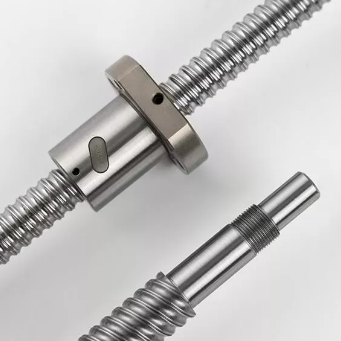
Computer Numerical Control (CNC) equipment demands absolute perfection. Ball screws drive the precise axis positioning inside these tools. Manufacturers rely on them to drive backlash down to absolute zero. Metal cutting forces are highly dynamic and violently unpredictable. These actuators provide the high rigidity necessary to withstand cutting forces without experiencing shaft deflection.
Modern assembly lines move continuously. Articulated robotic arms require rapid, repeatable joint articulation. Automated assembly lines and high-speed pick-and-place systems depend on rolling actuators. They handle continuous, high-speed movement effortlessly. Unlike sliding mechanisms, they perform these rapid cycles without overheating or seizing.
Aerospace applications leave absolutely zero margin for error. Flight control surfaces rely on precise linear actuation. Flaps and landing gear deployment systems use these mechanisms heavily. Missile guidance systems incorporate them for fin adjustment. Reliability, compact size, and high-efficiency power conversion are non-negotiable in aerospace engineering.
Patient safety requires flawless motion control. Surgical robotics depend on sub-micron precision for delicate procedures. Heavy imaging systems also utilize these components. Moving an MRI patient table requires perfectly smooth actuation. Any vibration could ruin sensitive imaging data. Ball screws deliver the vibration-free motion required.
Automakers deploy these systems across the factory floor. Heavy-duty robotic welding stations use them for fast positioning. Beyond the factory, they sit inside the vehicles themselves. Electric power steering systems utilize rolling screw mechanisms. They convert the driver's steering input into precise wheel angles efficiently.
Choosing between linear motion technologies requires a clear comparison. Below is a structured chart outlining the core engineering differences.
Evaluation Metric | Ball Screw | Lead Screw |
|---|---|---|
Mechanical Efficiency | ~90% | 20% – 25% |
Ideal Load Profile | High-load, continuous duty, high-speed | Light-load, intermittent use |
Friction Type | Rolling friction (steel bearings) | Sliding friction (direct thread contact) |
Self-Locking Ability | No (Prone to back-driving) | Yes (Often self-locking) |
Relative Cost | High initial investment | Low barrier to entry |
A ball screw operates at roughly 90% mechanical efficiency. They dominate high-load, continuous, and high-speed industrial applications. Conversely, lead screws average 20 to 25% efficiency. Lead screws function best in light-load, intermittent applications. They also win where high customization is prioritized. Engineers can swap lead screw nuts rapidly for quick prototyping.
High efficiency introduces a critical safety drawback. Friction is remarkably low inside a rolling assembly. A vertical load can easily push the nut downward if power is lost. This forces the screw to rotate backward rapidly. Engineers call this back-driving. To evaluate safety correctly, you must account for this risk. Ball screws inherently require supplemental holding brakes on vertical axes. Lead screws are often entirely self-locking under load.
Lead screws offer a lower barrier to entry. They fit perfectly into budget-conscious designs. Standard desktop 3D printers use them extensively for Z-axis movement. Ball screws represent a significant premium investment. However, manufacturing plants easily justify this upfront cost. Increased system longevity and supreme precision offset the initial expenditure over time.
Manufacturers produce screw shafts using two primary methods. Each suits specific industrial environments.
Rolled (Cold Deformed): Machines press metal blanks through heavy dies. This cold deformation hardens the steel. Rolled screws are highly durable and carry a lower cost. They are entirely sufficient for general automation tasks.
Ground (Precision Machined): Grinding machines cut threads using abrasive wheels after heat treatment. Ground screws carry a much higher cost. They deliver a supreme surface finish. You need them for extreme accuracy, specifically hitting C0 to C5 tolerance grades.
Many procurement specialists confuse pitch and lead. You must clarify the engineering difference. Pitch is the straight-line distance between two individual threads. Lead is the linear distance the nut travels in one full 360-degree rotation. Higher leads increase linear speed dramatically. However, increasing the lead steepens the thread load angle. A steeper angle slightly reduces the relative load-carrying capacity of the shaft.
Backlash is the tiny mechanical play between the nut and the screw. Preloading eliminates it by creating intentional elastic deformation. This internal tension maximizes system rigidity. Engineers typically evaluate three common preloading methods:
Oversized Balls: Inserting slightly larger steel balls creates a tight interference fit inside the grooves.
Double Nut with Spring: Two separate nuts are installed on the shaft. A tension spring pushes them apart continuously.
Offset Lead Preloading: A single nut features a slight shift in its internal thread pitch halfway through the body.
Speed and weight define the operational envelope. Critical Speed marks the rotational threshold where the screw shaft hits natural resonance. Hitting this speed causes violent vibration. A standard engineering rule of thumb exists here. Safe operational design strictly limits max velocity to 80% or less of the calculated critical speed. Buckling Load defines the physical breaking point. It measures the maximum compressive axial load applied before the metal shaft bends permanently.
Rolling bearings remain highly sensitive to environmental debris. Metal chips or dust destroy the internal raceways quickly. You must understand the necessity of proper sealing. Installing internal wipers pushes debris away from the nut. You also need protective enclosures in harsh environments. Rubber or leather bellows accordion over the shaft. They seal the mechanical components away from airborne contaminants.
Lubrication provides a microscopic fluid film between the steel balls and the groove. High-end screws often use a Gothic arch thread profile. This V-shaped arch provides excellent four-point contact for heavy loads. However, inadequate lubrication breaks this fluid film down rapidly. Bearings then scrape against the arch directly. This leads to severe metal-to-metal micro-tearing. Mechanics refer to this catastrophic failure as galling.
Steel balls naturally travel in the same direction inside the nut raceway. Adjacent load-bearing balls rub against each other during rotation. This friction generates operating noise and accelerates wear. Manufacturers solve this by inserting spacer balls. Spacer balls are alternating, slightly smaller inactive balls. They rotate in the opposite direction at the contact point. This brilliant engineering trick prevents collisions, reduces friction, and silences the assembly.
Predictability drives industrial purchasing decisions. Components must perform reliably over extended periods. Engineers calculate expected fatigue life before procurement. Standard operational lifecycles average 5 years or 20,000 continuous hours. Many rate them for 50,000 kilometers of total travel. You must specify the load and environment correctly to hit these numbers. Achieving this baseline allows facility managers to plan maintenance schedules accurately.
Select for efficiency and speed: Choose rolling linear actuators when system requirements dictate high efficiency, absolute precision, or continuous duty cycles.
Leverage torque reductions: Use the mechanical advantage to minimize drive motor size and lower adjoining hardware expenses.
Account for secondary costs: Always evaluate the need for supplemental braking mechanisms due to back-driving risks.
Protect your investment: Budget for protective bellows and robust wipers to handle severe contamination control.
Consult the experts: Encourage your design team to consult application engineers. Finalize your calculations for critical speed, buckling load, and preloading parameters before finalizing procurement.
A: The primary difference lies in the friction mechanism. Ball screws use rolling ball bearings inside the nut, achieving up to 90% mechanical efficiency. Acme screws use traditional sliding thread contact, yielding only 20-25% efficiency. Rolling mechanisms generate less heat, last much longer under heavy loads, and provide greater accuracy.
A: Yes, they can be manually driven via handwheels. However, this carries significant safety risks. The extreme low friction makes them highly susceptible to back-driving. If an operator releases the handwheel under a vertical load, the machine head can freefall backward. You must implement holding brakes for manual feeds.
A: A Gothic arch refers to the specialized, slightly V-shaped groove profile cut into the screw shaft and nut. Unlike a simple semi-circle, the Gothic arch creates distinct four-point contact with the steel balls. This geometry perfectly balances heavy axial loads coming from multiple directions simultaneously.
A: When properly specified, standard operational lifecycles average 20,000 hours. In terms of distance, they reliably cover 50,000 kilometers. You must maintain optimal lubrication, adhere to rated load limits, and prevent environmental contamination to achieve this predicted baseline.


