
- All
- Product Name
- Product Keyword
- Product Model
- Product Summary
- Product Description
- Multi Field Search
A Ball Screw is a highly efficient mechanical linear actuator. It translates rotational motion into precise linear motion using rolling ball bearings. This rolling action creates minimal friction. As a result, these components operate smoothly and handle immense loads.
Specifying the wrong linear motion component creates severe engineering risks. You might face premature system failure. You could experience unacceptable positioning backlash. Alternatively, you might waste your budget on unnecessary ultra-precision parts.
Engineers must balance precision requirements against mechanical reality. This article provides a definitive, decision-stage framework. You will learn how to evaluate, size, and select a Ball Screw correctly. We will explore payload dynamics, accuracy classifications, and operational environments. By the end, you will know exactly which linear actuator fits your application.
Efficiency jump: Ball screws operate at up to 90% efficiency, utilizing rolling friction to require roughly 1/3 the motor driving torque of traditional sliding lead screws.
Manufacturing dictates capability: Rolled screws offer cost-effective durability for standard automation, while ground screws deliver micron-level accuracy for CNC and aerospace applications.
Backlash elimination: System rigidity and zero-backlash operation are achieved through specific preloading methods (e.g., oversized balls, double-nut offsets).
Design trade-offs: The high efficiency of a ball screw makes it back-drivable; vertical applications typically require auxiliary braking systems.
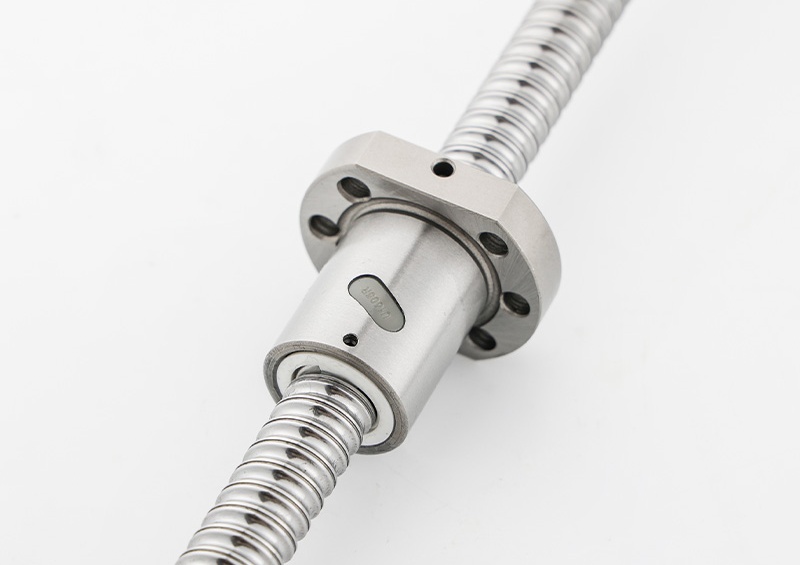
To understand performance, we must examine friction. Traditional threaded rods rely heavily on sliding friction. Thread faces rub directly against each other. This generates excessive heat and accelerates wear. A Ball Screw fundamentally changes this dynamic.
It replaces sliding contact with rolling contact. Steel balls circulate between the nut and the shaft. This rolling action drastically reduces heat generation. It protects the metal surfaces from rapid degradation. Efficiency soars as a direct result.
Three primary components drive this system. Each plays a distinct role in linear positioning.
Threaded Shaft & Nut: This is the main body. It houses a precision-machined helical raceway. The nut travels along this shaft as it rotates.
Recirculation System: Balls must circulate continuously. Internal return mechanisms use small deflectors or buttons to route balls over the thread crest. They are highly compact. External return mechanisms use visible tubes on the nut exterior. They handle larger balls and higher speeds easily.
Gothic Arch Profile: The raceway groove shape matters. Most designs use a Gothic arch geometry. This profile ensures four-point contact between the ball and the groove. Four-point contact yields much higher load capacities. It also increases structural rigidity.
Engineers frequently debate between these two technologies. Both convert rotational energy into linear motion. However, their performance baselines differ wildly.
A standard Ball Screw offers over 90% mechanical efficiency. Contrast this with Acme or lead screws. They typically hover between 20% and 30% efficiency. Rolling friction requires only about one-third of the motor torque compared to sliding friction.
Feature | Lead Screw | Ball Screw |
|---|---|---|
Friction Type | Sliding contact | Rolling contact |
Efficiency | 20% - 30% | 90%+ |
Self-Locking | Yes (mostly) | No (back-drivable) |
Motor Torque Needed | High | Low (roughly 1/3) |
Noise Level | Silent operation | Audible ball recirculation |
Lead screws win in specific scenarios. Budget constraints often dictate their use. They excel in vertical lifting applications where you need self-locking capabilities. Because friction is high, gravity alone cannot drive them backward. This eliminates the need for holding brakes.
They also survive high-vibration environments better. Without small moving balls, fewer parts can fail. Finally, lead screws operate silently. Medical scanners or office automation often require this silent operation.
Certain use cases are non-negotiable. You must use rolling friction for high-speed continuous cycling. Lead screws will melt or degrade rapidly under such duty cycles. You also need them for massive load capacities.
If you require micro-stepping accuracy, rolling friction is mandatory. It prevents "stiction" (static friction sticking). Finally, they lower your torque requirements. This lets you use smaller motors and extends overall motor lifespan.
Manufacturing methods dictate accuracy and price. The industry divides these components into two primary production categories.
Rolled manufacturing relies on cold extrusion. Dies press the thread shape into unhardened steel blanks. The manufacturer hardens the surface after forming the threads.
This process is fast and produces minimal material waste. Therefore, it is highly cost-effective. These units provide excellent durability. They suit material handling, standard robotics, and packaging equipment. In these applications, standard lead accuracy is perfectly acceptable.
Ground manufacturing takes the opposite approach. The manufacturer heat-treats the steel blank first. Then, they machine the threads using precision abrasives.
Grinding after heat treatment eliminates thermal distortion. The result is unparalleled precision. You will find these in semiconductor manufacturing. They drive high-end CNC routing machines. Medical surgical robots also rely on this micron-level accuracy.
Engineers grade accuracy using the JIS standard scale. It runs from C0 (highest precision) to C10 (lowest precision).
C0 to C3: Ultra-precision grades. Exclusively ground. Used in aerospace and optics.
C5: The standard crossover point. Used in CNC machining.
C7 to C10: Standard precision. Mostly rolled. Used in general automation.
You select a class based on cumulative lead error. Engineers measure this as allowable error per 300mm of travel (e300). A C5 grade allows roughly 18 microns of deviation per 300mm. A C7 grade allows up to 50 microns. You must match the grade to your positioning needs.
Precision systems cannot tolerate axial play. We call this play "backlash."
Backlash degrades bidirectional positioning accuracy. When the motor reverses direction, the nut pauses briefly. The screw turns, but the nut does not move until the internal gap closes. Preloading solves this positioning problem. It forces the internal components into constant, tight contact.
Manufacturers eliminate axial clearance using three main strategies.
Oversized Balls: Technicians inject bearings slightly larger than the groove space. This creates a light-to-medium preload. It is highly cost-effective and fits within a standard single nut.
Offset Lead: The manufacturer shifts the thread pitch slightly inside a single nut. This shift creates tight internal tension. It forces the balls against opposing sides of the groove.
Double-Nut with Spacers/Springs: The manufacturer stacks two separate nuts on the shaft. They insert a spacer or spring between them. This pushes the nuts apart (or pulls them together). It completely eliminates axial clearance. This provides extreme rigidity. It represents the highest cost but delivers the highest performance.
Preloading is not free. Excessive preload increases starting torque. The motor must work harder just to initiate movement. Constant tight contact also increases internal wear. Consequently, aggressive preloading reduces overall component lifespan. You should only apply the minimum preload necessary for your accuracy requirements.
Selecting the right Ball Screw involves rigorous mathematical checks. You cannot simply guess the dimensions.
People often confuse pitch and lead. Pitch is the distance between consecutive thread crests. Lead is the linear distance the nut travels in one full rotation. The math is simple: Lead = Pitch × Starts.
A single-start thread means the lead equals the pitch. A multi-start thread features multiple independent thread grooves. Multi-start designs increase linear speed dramatically. They allow fast movement without exceeding safe rotational RPM limits.
Long, thin shafts vibrate when spun too fast. We call this shaft whipping. You must calculate the critical speed.
Engineers mandate staying below 80% of the shaft's resonant frequency. Additionally, you must check the Dn value. You calculate this by multiplying the nominal shaft diameter (D) by the rotational speed (n). High Dn values indicate severe stress on the ball return mechanisms. Exceeding limits will shatter the recirculation tubes.
Compressive forces can bow the shaft. This is buckling. End-fixity alters the compressive load capacity.
A "Fixed-Free" mounting holds one end tight and leaves the other floating. It has low buckling resistance. A "Fixed-Fixed" mounting secures both ends rigidly in bearing blocks. This configuration handles massive compressive loads. Always verify buckling limits based on your planned bearing supports.
Failure is predictable. Engineers use the dynamic load rating (Ca) to calculate expected life. This rating dictates the L10 life calculation. It predicts how long 90% of identical units will survive under a specific load.
Sometimes, balls bunch up and rub against each other. This ball-to-ball friction reduces life. High-end designs add spacer balls. These are slightly smaller balls placed between the load-bearing balls. They act as rotary idlers. They prevent friction, ensuring the system meets its expected life design.
Even perfectly sized systems fail if installed incorrectly. You must address operational risks.
We discussed the ~90% mechanical efficiency earlier. This efficiency creates a unique danger. The system is back-drivable. If power is lost, gravity can pull the load downward. The falling load will physically spin the screw backward.
You cannot rely on motor friction to hold a vertical load. You must specify holding brakes. Auxiliary braking systems are mandatory to prevent catastrophic drops during power failures.
These components hate dirt. Unlike sliding lead screws, which can push debris away, rolling systems draw particles in. Dust acts like an abrasive grinding paste inside the nut.
They are highly vulnerable to particulate ingress. You must protect them. Emphasize the need for wipers on the nut ends. Use protective bellows in dirty environments. Proper sealing is not optional in woodshops or metal grinding facilities.
Steel rolling on steel requires a protective film. They cannot run dry.
You must provide continuous lubrication. Without grease or oil, metal-on-metal galling occurs immediately. This destroys the raceway geometry. Follow the manufacturer's intervals strictly. Automated grease pumps are highly recommended for continuous-duty applications.
Selecting the ideal linear motion system requires careful analysis. It remains an exercise in balancing precision requirements, load profiles, and budget constraints. You must evaluate critical speeds, buckling loads, and accuracy grades to ensure reliable operation.
Avoid over-specifying accuracy if standard rolled manufacturing meets your needs. Conversely, never under-specify load capacity to save money. Proper preloading and environmental protection will dictate the ultimate success of your machine design.
Ready to finalize your mechanical design? Utilize a product configuration tool or download a 3D CAD library from your supplier. For complex vertical lifting or high-speed automation, submit an engineering consultation form. Let experts help you calculate specific Dn values and required buckling loads.
A: Maximum speed depends heavily on the Dn value, thread lead, and shaft diameter. Small diameters whip at high RPMs. However, large-pitch designs using multi-start threads can reach linear speeds exceeding 2 meters per second without surpassing safe rotational limits.
A: No. Due to their extreme mechanical efficiency (often over 90%), they lack the friction required to hold a load in place. Gravity or external forces will back-drive them. They always require external braking systems in vertical applications.
A: Lifespan is highly predictable using the L10 life calculation formula. It is typically estimated in millions of revolutions or thousands of operating hours. Actual longevity depends strictly on the applied dynamic load, operating speed, and maintaining proper lubrication.
A: C5 is a standard accuracy grade defined by the JIS (Japanese Industrial Standards). It denotes a specific allowable cumulative travel error. A C5 grade guarantees maximum deviation of 18 micrometers per 300mm of thread travel, indicating high precision.


