
- All
- Product Name
- Product Keyword
- Product Model
- Product Summary
- Product Description
- Multi Field Search
Views: 109 Author: Site Editor Publish Time: 2026-01-21 Origin: Site
From CNC machines to automatic doors, many modern devices rely on smooth, precise straight-line movement. This motion is made possible by a key mechanical component—the linear guide, which ensures accurate positioning with minimal friction.
A linear guide is a mechanical system designed to support a load and guide it along a perfectly straight path. It works like a precision track, allowing moving parts such as cutting tools or robotic arms to travel smoothly and repeatedly with high accuracy. The terms linear guide, linear rail, and linear motion guide are often used interchangeably. In most cases, the linear rail refers to the fixed track, while the linear guide describes the complete system including both the rail and the moving carriage.
The linear guide rail is the foundation of any linear guide system. It is a precisely machined, straight track that is mounted to a stable base, defining the path of motion. Its main function is to provide a rigid, unyielding surface for the moving components to travel along.
This rail supports the entire system’s straight-line motion. By providing a hardened and ground surface, it ensures that the moving carriage can glide smoothly with high accuracy and repeatability. The precision of the guide rail is critical, as any imperfections can directly translate into errors in the final application, whether it’s an inaccurate cut from a CNC machine or a misaligned component in an automated assembly line. The rail is what makes precise, stable, and low-friction movement possible.
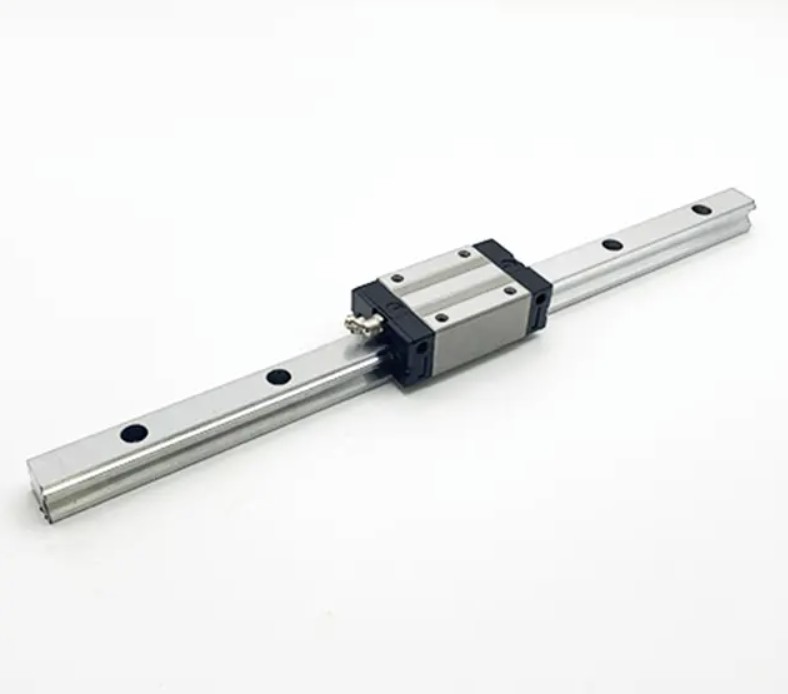
A linear guide system is deceptively simple, typically consisting of three primary components working in harmony to achieve smooth motion.
As discussed, this is the stationary, profiled track that is bolted to the machine’s frame. It serves as the path for the moving elements. Rails are usually made from high-strength steel to ensure rigidity and durability, and their length can be customized to match the required travel distance for an application.
Also known as the carriage, the linear guide block is the moving element that glides along the rail. The load that needs to be moved is mounted on top of this block. Inside the block are circuits that allow the rolling elements to recirculate continuously, enabling theoretically infinite linear motion along the length of the rail.
Housed within the guide block are the rolling elements, which are the key to the system’s low-friction movement. These are typically either steel balls or cylindrical rollers. They circulate within pathways between the guide block and the grooves on the guide rail, effectively creating a rolling interface that dramatically reduces friction compared to a simple sliding surface.
The genius of a linear motion guide lies in its ability to convert high-friction sliding motion into low-friction rolling motion.
Traditional sliding systems, where two flat surfaces slide against each other, suffer from high friction, which requires more force to initiate and sustain movement. This friction also generates heat and causes significant wear over time, reducing the system’s accuracy and lifespan.
A linear motion guide overcomes this by using rolling elements. As the guide block moves along the rail, the balls or rollers inside it roll between the block and the rail. This rolling action has a much lower coefficient of friction than sliding. The balls or rollers circulate through a path within the block, so as they exit the load-bearing zone at one end, they loop back to the other end to re-enter, allowing for continuous, smooth motion.
This design not only ensures smooth movement but also provides excellent load support and stability. The shape of the grooves on the rail and within the block (raceways) is designed to create a large contact area with the rolling elements. This distributes the load evenly, allowing the system to handle substantial forces from multiple directions—radially, reverse-radially, and laterally—while maintaining high rigidity.
Linear guides come in various designs to suit different application requirements, primarily distinguished by the type of rolling element they use.
This is the most common type, using steel balls as the rolling elements. Ball-type guides are ideal for applications requiring high speed, smooth motion, and moderate load capacity. Their design, which often features circular-arc grooves, allows for a large contact area with the balls, increasing load capacity compared to flat surfaces. They are versatile and widely used in applications like 3D printers, CNC machines, and medical devices.
Instead of balls, these guides use cylindrical rollers. The key advantage of rollers is their larger contact area compared to balls, which gives them a significantly higher load capacity and greater rigidity. This makes roller-type guides the preferred choice for heavy-duty applications, such as large machine tools, industrial automation, and material handling systems where extreme loads and high stiffness are required.
As the name suggests, these are compact versions of standard linear guides, designed for applications where space is limited. They are commonly used in smaller devices like electronic equipment, optical instruments, and small-scale precision positioning systems. Despite their small size, they still offer high precision and reliability for light-load applications.
The adoption of linear guides in modern machinery is driven by several key benefits that are difficult to achieve with other motion systems.
Linear guides are engineered for exceptional accuracy. The low-friction rolling motion and rigid construction minimize deviations from the intended path, allowing for highly repeatable and precise positioning, which is essential in applications like machining and measurement.
The use of rolling elements drastically reduces friction. This means less force is required to move a load, resulting in lower energy consumption, less heat generation, and smoother operation, even at high speeds.
The design of the raceways ensures that the rolling elements have a large contact area, allowing linear guides to support heavy loads from all directions. Roller-type guides, in particular, excel at handling very high load requirements. According to THK, a pioneer in the field, this design can increase the permissible load by approximately 13 times compared to a point-contact system with a similar-sized ball.
The low-friction operation minimizes wear and tear on the components. When properly lubricated and protected from contaminants, linear guides can operate reliably for a very long time, reducing maintenance needs and machine downtime.
The precision and reliability of linear guides make them indispensable in a wide array of industries and applications.
CNC Machines: Linear guides are used on all axes to ensure the cutting tool or workpiece is positioned with extreme accuracy.
Automation Equipment: In factory automation, they guide robotic arms, transfer systems, and assembly line components.
Robots: Industrial robots use linear guides for precise joint movements and positioning.
3D Printers: They guide the print head and build platform, ensuring accurate layering of material.
Medical Devices: Used in imaging equipment like CT scanners, as well as in diagnostic and lab automation machines where precise sample handling is critical.
Selecting the right linear guide for an application is crucial for optimal performance. Several factors must be considered:
Load: What is the magnitude and direction of the forces the guide will need to support? This will determine the required size and whether a ball or roller type is more appropriate.
Speed: How fast will the carriage need to move? High-speed applications require guides designed to handle rapid acceleration and smooth motion.
Accuracy: What level of precision and repeatability is needed? Higher-precision applications require guides with tighter manufacturing tolerances.
Environment: Will the guide be exposed to dust, debris, moisture, or corrosive chemicals? In harsh environments, seals, scrapers, and special coatings or materials (like stainless steel) are necessary to protect the guide and ensure its longevity.
A linear guide is used to support and guide a load along a straight path with high precision and low friction. It is a critical component in machinery like CNC machines, 3D printers, industrial robots, and automation systems where accurate linear motion is required.
The terms are often used interchangeably, but “linear bearing” can sometimes refer to a simpler component, like a ball bushing that slides on a round shaft. A “linear guide” or “linear motion guide” typically refers to the more robust system with a profiled rail and a matching carriage block, which offers higher load capacity and rigidity.
Yes, lubrication is crucial for the proper functioning and long service life of a linear guide. Grease or oil reduces friction between the rolling elements and raceways, prevents corrosion, and helps dissipate heat. Most manufacturers provide lubrication guidelines for their products.
The service life of a linear guide depends on several factors, including the applied load, operating speed, lubrication, and environmental conditions. When properly selected, installed, and maintained, a linear guide can operate for thousands of kilometers of travel, often outlasting the machine it is part of.
A linear guide is far more than just a track for movement; it is a high-precision engineering system that underpins the accuracy, efficiency, and reliability of modern machinery. By converting sliding friction to rolling friction, these guides enable heavy loads to be moved with minimal effort and maximum precision.
When choosing a linear guide, always start by carefully evaluating your application’s requirements for load, speed, accuracy, and operating environment. Consulting manufacturer catalogs and technical documents will provide the detailed specifications needed to make an informed decision. By selecting the right guide, you ensure your machine will perform at its best, delivering smooth, reliable, and precise motion for years to come.
At Prio, we design and supply precision motion components for modern automation systems. From ball screws to complete linear solutions, we support equipment builders with reliable products, technical guidance, and flexible customization to help turn complex motion challenges into stable, scalable results.


