
- All
- Product Name
- Product Keyword
- Product Model
- Product Summary
- Product Description
- Multi Field Search
Views: 0 Author: Site Editor Publish Time: 2026-04-29 Origin: Site
Predicting machinery lifespan is often a delicate balancing act for industrial specifiers and automation engineers. Under-specifying your linear motion components inevitably leads to catastrophic machine downtime. Conversely, over-engineering them dramatically inflates your Bill of Materials (BOM) costs and wastes physical space. Unlike traditional sliding-contact lead screws, a Ball Screw offers highly predictable wear characteristics due to its rolling contact mechanics. Engineers can mathematically model exactly how long these assemblies will survive under specific axial loads. This article provides a transparent, data-driven framework for calculating expected life. You will learn how to manage operational variables, interpret fatigue benchmarks, and evaluate technical trade-offs before making final procurement decisions. We will explore industry-standard evaluation metrics, expected endurance baselines across various sectors, and the physical degradation paths you must monitor closely.
Statistical Baseline: Industry standards evaluate ball screw life using the L10 metric, representing the lifespan at which 90% of a given sample remains fully operational without fatigue failure.
The "Inverse Cube" Multiplier: Ball screw lifespan follows a strict inverse cube relationship with load. Reducing the applied load by just 20% can nearly double (extend by ~95%) the expected service life.
Typical Endurance: Properly maintained industrial ball screws typically yield 10,000 to 20,000 hours of continuous service, scaling up to 30,000 hours under optimal conditions.
Preload Trade-offs: While increasing preload eliminates backlash, it introduces constant internal stress that subtly reduces overall rated life and efficiency.
"Lifetime" is not an arbitrary marketing claim. It remains a precise statistical probability derived from extensive material testing. Manufacturers universally use the L10 life metric to define baseline endurance. This standard signifies the exact operational point where 10% of identical units show initial signs of metal fatigue. You will typically see this fatigue manifest as surface flaking on the internal raceways. Facilities test these units under strictly identical operating conditions. This statistical baseline means 90% of the assemblies will survive well past this rating. Industrial engineers rely on this 90% reliability threshold to schedule preventative maintenance safely.
To calculate this endurance limit, engineers rely on the Dynamic Load Rating (Ca). Ca represents the constant axial load enabling a unit to achieve exactly 1,000,000 continuous revolutions. It assumes a perfect theoretical environment. The model assumes pure axial forces, clean lubrication, and zero structural misalignment.
When sourcing components globally, you will inevitably encounter unit variations between markets. These regional discrepancies require careful conversion before finalizing your designs. Metric markets evaluate endurance differently than imperial markets.
System Architecture | Lifespan Measurement Baseline | Standard Evaluation Benchmark |
|---|---|---|
Metric Configurations | Total Revolutions | 106 (One Million) Revolutions |
Imperial Configurations | Inches of Travel | 106 (One Million) Inches of Travel |
These differing benchmarks demand strict attention during your design phase. A Ball Screw rated for a million inches of travel will far outlast one rated merely for a million revolutions if your thread pitch is small. You must align your mathematical formulas strictly alongside the correct regional standard to avoid catastrophic under-sizing.
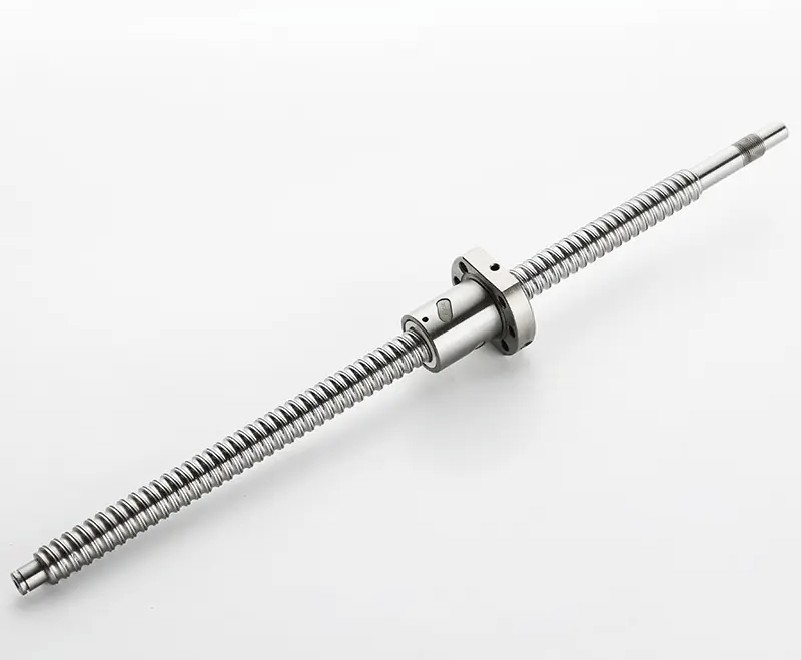
We establish standard operational limits ranging between 10,000 and 20,000 hours for typical industrial applications. You can stretch this baseline to 30,000 hours through meticulous lubrication regimens and strict load management. However, different manufacturing sectors demand vastly different reliability margins.
Decision-makers need standard engineering targets to prevent costly over-specification. Here are typical sector-specific benchmarks you should follow:
Machine Tools / CNC: Target ~20,000 hours. These machines face rigorous precision requirements alongside heavy, continuous cutting forces. Operating multiple shifts per day requires robust endurance margins.
Measurement Instruments: Target ~15,000 hours. High accuracy remains absolutely critical here. Fortunately, operational loads usually remain relatively light.
Industrial Automation / General Transfer: Target ~10,000 hours. These systems often handle high-speed material movements. They can tolerate minor physical wear before positioning accuracy drops unacceptably.
You should use these baselines to pressure-test specific vendor claims. Evaluate your actual machine lifecycle realistically. If a packaging machine requires five years of single-shift operation, buying a 50,000-hour rated assembly offers no practical return on your investment. Always match the component endurance rating to your realistic production schedule and usage intensity.
Lifespan is inversely proportional to the cube of the applied load. This mathematical reality stands as the absolute most critical calculation for procurement engineers. It dictates exactly how physical forces translate directly into operational survival time.
The unforgiving math works strictly like this: if you double your applied load, the lifespan drops to one-eighth (12.5%) of its original rating. A seemingly small increase in physical force causes massive, disproportionate reductions in mechanical longevity.
Consider the tremendous cost-saving strategy behind this specific equation. If you over-size the unit slightly during the design phase, you effectively reduce the actual load relative to its rated capacity. Cutting the applied operational load by 50% multiplies the expected lifespan by a factor of eight. This equals two to the power of three.
Real-world applications rarely experience perfectly constant forces. Fluctuating loads require careful mathematical calculation. Buyers must determine the equivalent continuous load for their specific duty cycles. You do this by calculating a mean axial load across the entire movement profile. Remember to separate positive and negative directional forces during your analysis. Unidirectional calculations fail when machinery pushes and pulls payloads alternately.
Applied Load vs Rated Capacity | Expected Lifespan Multiplier (Inverse Cube) | Practical Outcome |
|---|---|---|
200% (Double the Load) | 0.125x Baseline | Lifespan drops to 1/8th. Rapid failure expected. |
100% (Exactly Rated Load) | 1.0x Baseline | Unit meets its stated L10 rated life. |
80% (Reduce Load by 20%) | ~1.95x Baseline | Lifespan nearly doubles. Highly recommended practice. |
50% (Reduce Load by Half) | 8.0x Baseline | Unit lasts 8 times longer than the rated baseline. |
Theoretical calculations always assume pristine laboratory conditions. Factory floors, however, introduce severe wear accelerators.
Vibration and shock heavily skew the fundamental mathematical models. Strong machine vibrations or travel speeds exceeding two meters per second require a specific load factor adjustment (fW). This fW factor can mathematically double or triple your equivalent continuous load. You must multiply your base operational load by this safety factor. This step ensures your math reflects dynamic structural shocks accurately.
Environmental contaminants pose another severe threat to longevity. Dust, debris, and abrasive metallic particles quickly destroy internal raceways. Wood dust in CNC routers easily mixes into lubricating grease. This combination forms a highly abrasive paste inside the nut. You must explicitly specify wiper rings or seals at both ends of the nut assembly. These components physically plow harmful debris away from the sensitive ball tracks. They act like miniature snowplows constantly protecting the internal rolling mechanisms.
Engineers must also strictly respect critical speed limitations. A rotating shaft spinning too fast eventually approaches its natural resonant frequency. Industry professionals call this the whirling speed. Standard design practice mandates keeping maximum rotational speeds safely below 80% of this critical threshold. Exceeding this rotational limit causes violent system vibrations, bent shafts, and rapid catastrophic failure.
Finally, consider the inherent preload paradox in high-precision designs. Preloading increases overall system rigidity and completely eliminates backlash. However, it introduces constant artificial contact stress between the steel balls and the raceway. This continuous internal tension causes a two to five percent drop in transmission efficiency. It inherently cuts into the mathematical L10 lifecycle. You must carefully balance the need for extreme positioning precision against premature material fatigue. Over-preloading destroys components faster than heavy external loads.
Operations and maintenance teams need physical diagnostic criteria to identify failing components early. Metal fatigue follows a highly predictable three-stage material degradation path. You can track these objective signs of failure well before catastrophic seizing occurs on the production floor.
Micro-Pitting: This marks the initial stage of fatigue. Nearly invisible surface craters begin forming on the nut grooves or the shaft raceway. These tiny pits typically measure around 0.2mm in diameter. They indicate the very beginning of subsurface material failure.
Cracking: The degradation accelerates rapidly during this second phase. Pits expand into micro-fissures under continuous rolling stress. The structural integrity of the hardened steel begins dropping significantly.
Flaking / Peeling: The final failure stage arrives. Hardened material physically detaches from the screw shaft surface. The rolling elements can no longer traverse the raceway smoothly. The unit has officially failed its L10 lifespan.
Beyond physical visual inspections, operators must look for specific system-level symptoms. Listen closely for sudden, unexplained increases in rotational noise. Monitor your servo drives meticulously for noticeable friction spikes or increased electrical current draws. You will also observe a distinct, measurable loss of repeatability in machine positioning. When a CNC machine struggles to hold its tight dimensional tolerances, the internal raceways have likely entered the flaking stage. Replacing the degraded unit immediately prevents expensive secondary damage to servo motors and linear guide rails.
Extending component life is not simply about purchasing the most expensive unit available. It requires precise engineering discipline and consistent operational awareness. Keep these final action-oriented steps in mind as you finalize your machinery designs:
Calculate your exact average axial loads across the entire movement cycle.
Apply the inverse cube law to find the optimal balance between initial component size and lifecycle longevity.
Specify proper wiper seals to mitigate non-axial forces and block environmental debris.
Cross-reference your operating speeds against the 80% critical speed threshold to prevent resonance.
Encourage your engineering teams to cross-reference their force profiles against manufacturer dynamic load ratings (Ca). Managing your structural load margins effectively guarantees maximum mechanical reliability over time. Right-sizing your procurement decisions ensures smooth production cycles and eliminates unnecessary replacement costs.
A: If rotational speeds remain strictly below 10 RPM, L10 dynamic calculations lose accuracy. Engineers must evaluate safety using the Basic Static Load Rating (C0) instead. This metric measures the load threshold just before permanent micro-deformation occurs. The standard defines this deformation limit as 1/10,000 of the rolling element diameter.
A: L10 represents the industrial standard requiring 90% reliability. Only 10% of units will fail at this baseline. L50 is the "median life," identifying the point where exactly 50% of units survive. L50 life runs about five times longer than L10. Utilizing L50 for industrial design is highly risky and generally discouraged.
A: Due to rolling mechanics, ball screws operate at 85%–95% efficiency. They transfer far less energy into destructive heat and friction. Traditional sliding-contact lead screws operate at only 20%–40% efficiency. This massive friction loss makes sliding lead screw wear rates significantly higher and far less statistically predictable under heavy loads.


